13 Enterprise AI Strategy Principles for Resilient Firms 2026
13 Enterprise AI Strategy Principles for Resilient Firms 2026

James Sullivan
James Sullivan
October 7, 2026
October 7, 2026

Most enterprises are running AI programs. Almost none are moving the P&L. Here is why the gap is a capital allocation failure, and the 13 principles that close it.
The common assumption is that AI projects are inherently difficult to tie to measurable financial outcomes; the best you can hope for is productivity gains that eventually show up somewhere in the numbers. That assumption is wrong, but it is doing real damage. Most enterprise AI programs don't fail because the technology breaks down.
They fail because the financial case was never built. Across operationally heavy mid-market businesses, the pattern repeats: a promising pilot, a polished demo, a dashboard no one checks six months later. The board asks what it returned.

Nobody has a defensible answer. See our AI transformation consulting for how this works in practice. Adoption is not the problem. According to the McKinsey State of AI 2025, only 6% of organizations qualify as AI high performers, defined as those achieving 5%+ EBIT impact. Sixty-one percent report no measurable P&L movement at all. Widespread adoption has produced, for most organizations, a graveyard of proofs-of-concept that never reached production.
6%
of organizations achieve 5%+ EBIT from AI
The selection problem is concrete. The most widely deployed AI applications are code copilots (51%), support chatbots (31%), and meeting summaries (24%): high-visibility, low-OpEx tasks.
Meanwhile, labor-intensive client-delivery workflows, the ones that compress margin, go untouched. Enthusiasm drives the selection, not math. Teams pick what is feasible and visible, not what carries the highest OpEx weight. That is a prioritization failure with a direct cost to EBITDA. Menlo Ventures 2025 also reported that enterprise AI spend hit $37 billion in 2025, with more than half concentrated in near-term productivity outputs rather than redesigned, high-OpEx workflows. Spend scaled. Margin did not.
$37 billion
enterprise AI spend in 2025, margin didn't follow
The pattern comes from the absence of financial discipline applied before a single dollar is committed.
Key takeaways
Most enterprise AI programs don't fail because the technology breaks, they fail because no one built a financial case before the kickoff meeting.
An AI initiative without a documented EBITDA return tied to it is a roadmap slide, not a strategy.
The majority of generative AI pilots never reach production; the gap between pilot and P&L impact is almost always a governance and prioritization failure, not a technical one.
Boards that approved one AI budget and got nothing back don't need a bigger commitment, they need a scored diagnosis of exactly which foundations are broken and what that's costing per quarter.
Maturity level determines which AI moves are available to a firm right now; skipping steps doesn't accelerate results, it multiplies waste.
OneSeven Tech's AI Readiness Assessment maps your organization to one of six maturity stages, human-led to agentic, scores you across five pillars against your industry, names what's broken, and delivers a 30-day roadmap with starter projects, tools, and the cost-of-inaction math your board actually needs to act.
What an Enterprise AI Strategy Actually Is in 2026
That assumption is compounded by a real cognitive trap many organizations fall into: leadership teams find themselves caught between two conflicting narratives, that AI will fix everything, or that it is mostly hype, so forming any coherent AI strategy relevant to their actual business context becomes nearly impossible, let alone an enterprise-level one.

Enterprise AI Strategy as a Capital Allocation Decision
An enterprise AI strategy is an organization-wide, coordinated plan that connects specific business goals to a prioritized AI portfolio, with explicit decisions made across data, technology, governance, talent, and funding, as the 4PSA Blog, The State of Enterprise AI in Q2 2026 makes clear. That framing is deliberate: strategy is not a roadmap or a pilot program, it is a capital allocation decision with measurable return expectations attached.
The distinction matters because capital allocation decisions require accountability structures that project timelines do not. A strategy answers: which business outcome does this initiative serve, what is the expected OpEx-to-EBITDA conversion, and what happens to the portfolio if this initiative underperforms? Two findings from current deployment data sharpen that framing further:
First, enterprise hesitation around AI adoption, not a lack of AI capability, has been identified as a primary bottleneck for large-scale deployment.
Trust and organizational readiness are as much a part of a real enterprise AI strategy as model selection is.
Second, enterprise AI safety and data security remain unresolved pain points: leadership teams regularly raise legitimate questions about how AI systems prevent leakage of sensitive financial data, and any strategy that does not address data governance explicitly will stall at the board level.
These are not soft concerns; they are capital allocation risks.
This is exactly the kind of board-level conversation OneSeven Tech is built to support. Through its Fractional Chief AI Officer (CAIO) offering, OneSeven Tech provides the strategic layer that answers board questions about AI strategy directly, including governance structures, data security boundaries, and portfolio prioritization, without requiring a full-time executive hire. That same discipline extends into how OneSeven Tech approaches individual AI capabilities. OneSeven Tech's Churn Prediction Model is a concrete example of that discipline in practice: a purpose-built AI/ML capability embedded into an existing digital product context, with a specific, measurable business outcome, revenue retention, as its governing metric from day one.
Why 88% of Enterprises Use AI but Few Extract Real EBIT Impact
Only approximately 6% of firms qualify as AI high performers, defined as organizations attributing 5% or more of EBIT directly to AI. The vast majority of companies running active AI programs cannot make that claim, and the other 94% are running active programs while generating almost no measurable P&L impact. The gap is not primarily a technology problem. It is a planning failure rooted in the absence of a real strategy, and one made worse when adoption hesitation and data governance concerns are treated as implementation footnotes rather than first-order strategic inputs.
Closing that gap requires structural controls, not more pilots. The 13 principles in the next section are the structural controls that separate firms generating documented EBITDA returns from those still running expensive experiments, and each one is framed as a financial decision, not a technology best practice.
Related Reading
Ai Implementation Challenges
Ai Transformation Roadmap
Ai For Operational Efficiency
Ai Readiness Checklist
Ai Project Management
Ai Value Creation
13 Enterprise AI Strategy Principles That Separate Resilient Firms From Expensive Experiments
Industry research, including analysis from Gartner covered by Revnew and reporting from the Washington Business Journal, consistently finds that the large majority of generative AI pilots never reach production. The ones that do stall share a common cause: no one defined a financial return before the kickoff meeting. That number is not a technology indictment.
It is a capital allocation indictment. Enterprise hesitation to adopt AI is itself a core bottleneck, and it directly reflects the strategic gap that separates resilient firms from expensive experiments. The firms that consistently convert AI spend into documented EBITDA impact treat each AI initiative as a financial control lever rather than a capability experiment. The 13 principles below are that discipline, made concrete.
1. Value-Led Alignment - Tie Every AI Initiative to a Named P&L Line Before Funding It

This is the minimum viable condition for any AI investment to be defensible to a board. Tie the initiative to a named revenue line, a specific cost center, or a measurable cycle-time reduction before a single dollar is committed. OneSeven Tech's work is built around exactly this discipline: every engagement is oriented toward measurable, documented ROI from AI investments, not capability demonstrations that look impressive in a slide deck and disappear from the budget by Q3.
2. Data Foundation as a Financial Asset - Treat Data Debt Like Balance-Sheet Debt

Data debt compounds exactly like financial debt: it accrues silently, blocks productive work, and eventually forces a write-down. A logistics firm that discovers its dispatch data lives in three disconnected systems after scoping an AI routing initiative has hit an unaudited liability that no one put on the balance sheet. Data quality, accessibility, governance, and standardized architecture are preconditions for AI value, not implementation details. Audit data readiness before committing deployment capital, or the model will be the least of your problems.
3. Governance and Compliance as an EBITDA Protector, Not a Cost Center

Governance is risk-adjusted EBITDA protection. GDPR enforcement actions have resulted in substantial penalties for large violations, and the EU AI Act introduces additional liability tiers for high-risk AI systems. Enterprises that treat governance as overhead rather than insurance are underwriting an unpriced liability. The NIST AI Risk Management Framework and ISO/IEC 42001 are the two most widely adopted governance structures for enterprise AI; both require role-based access controls, model drift monitoring, and documented accountability chains. Building these in from the start costs a fraction of remediating a regulatory finding after deployment.
4. Workforce and Change Management - Budget the Human Transition as a Line Item, Not an Afterthought

The failure mode here is predictable: the model goes live, adoption stalls at 12%, and six months later the initiative is quietly shelved. Employee involvement in AI design and explicit reskilling investment are not soft-side considerations. They are the mechanism by which AI output converts to actual workflow throughput. Budget the human transition as a named line item with a target adoption rate, a training timeline, and a named owner. Framing AI as a tool that removes drudgery rather than headcount is the communication posture that consistently reduces resistance and accelerates time-to-value.
5. Sustainable Funding Models - Replace One-Time Pilot Budgets with Value-Linked Reinvestment Loops

One-time pilot budgets produce one-time results. The firms that generate compounding AI returns structure funding as a reinvestment loop: documented savings from Phase 1 automatically fund Phase 2 scope. This shifts AI from a discretionary technology line item to a self-financing capital program. The practical implication is that the first initiative must be scoped conservatively enough to generate a measurable, auditable return within 90 days, because that return is the evidence that unlocks the next allocation. Portfolio management discipline sustains the program past year one.
6. Use-Case Prioritization - Score Opportunities on EBITDA Impact Times Implementation Feasibility

Prioritizing AI use cases means focusing on high-frequency, high-cost manual workflows first, then balancing business value against data and technical feasibility. The scoring mechanism is simple: multiply estimated EBITDA impact by implementation confidence, then rank. Low-frequency, low-cost tasks score near zero regardless of how technically interesting they are.
The firms that escape pilot purgatory set a 90-day production deadline at scoping. If the use case cannot be architected for deployment within that window, it moves down the list. Speed to production is a financial variable, not a project management preference. OneSeven Tech's Churn Prediction Model is a direct example of this principle in practice: a high-frequency, high-cost problem, customer attrition, scored against measurable revenue impact and scoped for deployment, not indefinite experimentation.
7. Operating Models and MLOps - Production Reliability Is a Revenue Guarantee, Not a DevOps Nicety

Practitioners and enterprise AI implementation teams consistently report that meaningful MLOps maturity, covering drift monitoring, lifecycle ownership, and rollback readiness, requires sustained platform investment well beyond initial deployment, a timeline that mid-market firms frequently underestimate when scoping initial deployment budgets. A model that degrades silently in production is a revenue assurance problem.
Cross-functional squads with defined model lifecycle ownership, automated drift monitoring, and documented rollback procedures are the infrastructure that keeps AI-generated margin from evaporating between quarterly reviews. OneSeven Tech's Forward-Deployed Engineering model is structured to keep that ownership inside the business rather than diffused across a vendor relationship that ends at go-live. Treat MLOps spend as a revenue guarantee, not a technical overhead line.
8. Agentic AI Readiness - Establish Autonomous-Action Boundaries Before Agents Touch Live Systems
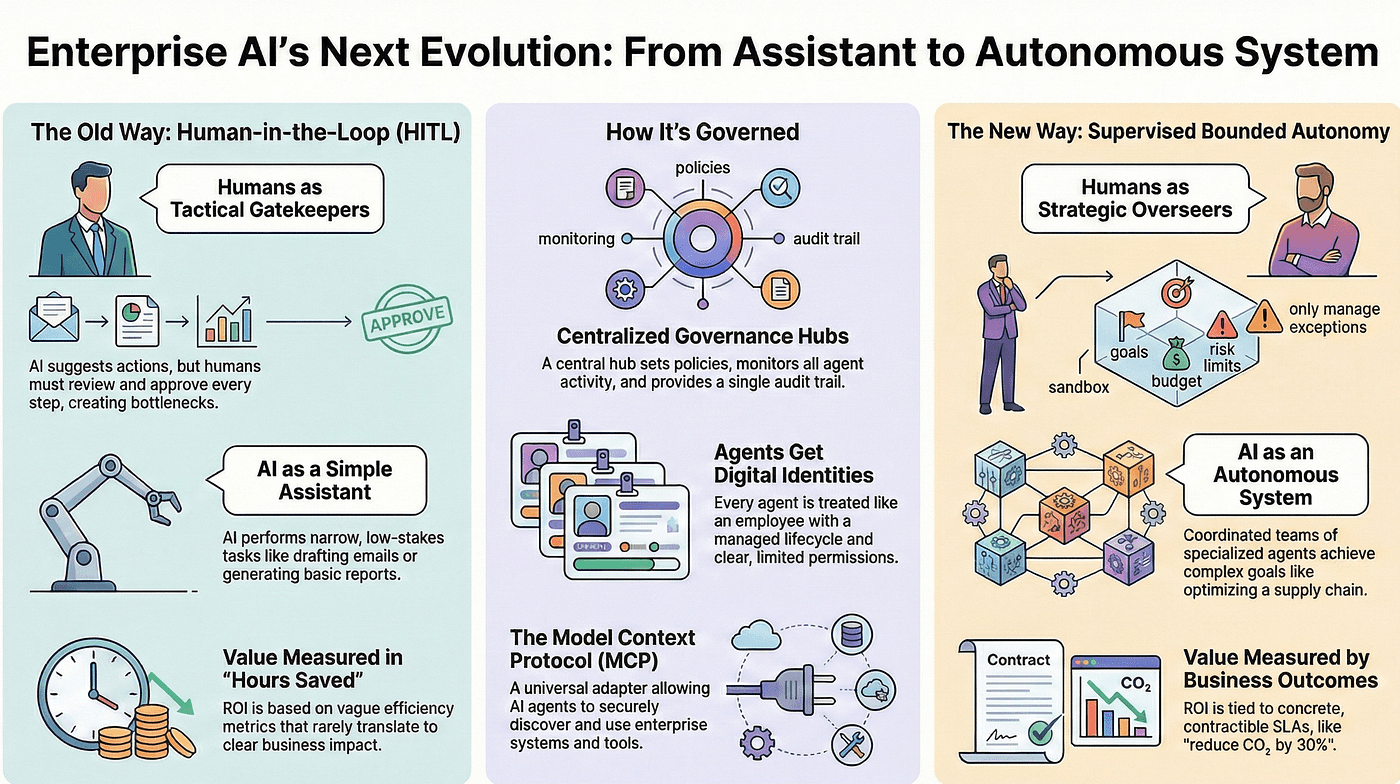
Agentic AI systems that act autonomously on live data, trigger transactions, or modify records without human review represent a qualitatively different risk profile than predictive models. The control question is where autonomous action is permissible and where it is not. Firms that skip this step and discover the boundary through a live error absorb an unplanned cost that will appear somewhere in the P&L before the quarter closes. OneSeven Tech's Agentic Voice AI capability is deployed within exactly this discipline: boundary conditions and audit trails are established before the agent touches a live system, not after the first incident surfaces a gap.
9. Workflow Redesign Over Bolt-On AI - Reengineer the Process First, Then Apply the Model

Workflow redesign is the strongest single predictor of AI financial impact. McKinsey's research on AI high performers shows that high performers are significantly more likely to report fundamental process redesign as a core AI practice compared to other organizations. Bolting a model onto a broken workflow produces a faster broken workflow.
The correct sequence is to map the process, identify the highest-cost decision or action point, redesign the workflow around AI augmentation, and then deploy the model into the redesigned process. OneSeven Tech's UX/UI Design practice is most valuable at this inflection point, during the discovery and build phases of a digital product, before and alongside development, to define and validate the user experience around redesigned workflows rather than layering AI onto whatever the existing interface already does. Sequence matters more than model quality.
10. AI Maturity Assessment - Know Your Current Capability Tier Before Committing Deployment Capital
Committing deployment capital without knowing your current AI maturity tier is the organizational equivalent of building on an unaudited foundation. Maturity spans a range from fully human-led operations to agentic, AI-first workflows, and the gap between where an organization is and where a proposed initiative assumes it is determines whether the initiative will succeed or stall. A structured assessment that scores across data readiness, talent, governance, infrastructure, and change capacity, mapped against industry benchmarks, converts a vague capability question into a sequenced investment decision.
McKinsey's research on AI high performers shows they are significantly more likely to have applied rigorous, documented capability evaluation before committing deployment capital. Internal reviews consistently underweight sequencing gaps because they are conducted by the same teams who made the original prioritization decisions, a structural bias that an external, structured assessment corrects.
11. Production-First Architecture - Design for Scale and Auditability from the First Line of Code
A financial services firm that ran 14 pilots over 18 months and promoted zero to production did not have a model quality problem. Every pilot was scoped as an experiment rather than a deployable system, so none had the auditability, access controls, or integration architecture required for production approval. Production-first architecture means designing for scale, security, and audit from the first line of code, not retrofitting those properties after a pilot succeeds.
OneSeven Tech's AI/ML Development practice is structured around this sequencing: most beneficial when a business has a defined use case and an existing or new digital product to integrate it into, and engaged during the product build phase, not after a prototype has already accumulated the technical debt that will block production approval. Industry practitioners and engineering economics literature consistently document that retrofitting production-grade properties onto a system originally scoped as an experiment costs substantially more than building for production from the start, with delays that can compound well beyond initial project timelines. The goal is a scalable operational infrastructure that doesn't break as the company scales, and that requires production-grade architecture decisions made at the start, not at scale.
12. Human-in-the-Loop Validation - Define Exactly Where Human Judgment Protects Margin
The same McKinsey research that surfaces the workflow redesign gap shows that AI high performers are far more likely to have formally defined human-in-the-loop validation protocols compared to other organizations. The gap is financial.
Automated decisions in pricing, credit, procurement, or customer escalation that bypass human review at the wrong moment convert model errors into P&L events. Define the specific decision points where human judgment is required, document the escalation criteria, and build the validation step into the workflow architecture rather than relying on individual discretion to catch errors after the fact. OneSeven Tech's Company Brain is designed with this principle as a structural constraint: institutional knowledge and decision context are surfaced to the right human at the right moment, rather than replaced by automated output that carries no accountability chain.
13. Internal Bandwidth as the True Scaling Constraint - Capacity to Absorb AI Is the Binding Limit, Not Model Availability

The most underreported reason enterprise AI portfolios stall is not model quality or data availability, it is the finite organizational bandwidth to absorb, validate, and operationalize new AI capabilities simultaneously. Firms that sequence deployments against measured internal absorption capacity, change management bandwidth, IT integration throughput, and business-unit adoption rate, consistently outperform those that maximize the number of concurrent pilots. This is the single info-gain principle most strategy frameworks omit. The tradeoff: capacity-constrained sequencing feels slow to boards expecting parallel progress.
Related Reading
Enterprise Ai Applications
Ai Implementation Best Practices
Ai Operational Efficiency
Ai Consulting Cost
Top Ai Consulting Firms
Ai Implementation Cost
Ai Implementation Partner
How an AI Readiness Assessment Scores Your Strategy Before You Spend Another Dollar
A board that already approved one AI budget and has nothing to show for it does not need a bigger commitment. It needs a diagnosis of why the first investment stalled before it can justify the next one. That is the gap most CEOs discover only after the second or third failed initiative, and by then the credibility damage is compounding alongside the sunk cost.
"Companies lack visibility into where AI is already embedded in their hiring processes, creating undetected governance gaps that an AI readiness assessment is designed to surface."
— what we hear from HR and compliance leaders

Six Maturity Steps, Five Scored Pillars, One Board-Ready Gap Map
The AI maturity model used as an industry-standard structure maps organizations to one of six steps, Human-led, Tech-enabled, AI-ready, AI-enhanced, AI-first, and Agentic, and scores them across five pillars. Each pillar is scored against sector benchmarks, and the company is placed on one of six maturity steps ranging from fully human-led operations to agentic AI execution. The output is a gap map: a visual, pillar-by-pillar breakdown showing precisely where the 13 principles are met, partially met, or absent, with the lowest-scoring gaps ranked by their financial drag.
Cost-of-Inaction Math Translating Pillar Scores Into Suppressed EBITDA
When organizations skip measuring their pre-AI baseline and scoring which cost structures are realistically automatable, they make it mathematically impossible to produce a defensible ROI answer afterward, because there is no delta to measure against. The AI readiness assessment corrects that sequencing problem by establishing the baseline first, then attaching a quarterly suppressed-EBITDA figure to each pillar gap. A governance gap that blocks deployment across three workflows is a calculable cost line. The output is a dollar figure, tied to a specific pillar, paired with a 30-day action that begins closing the gap.
Why a Structured AI Readiness Assessment Outperforms Another Internal Review
According to the RAND Corporation (2025), 84% of AI projects fail, and the cause is leadership and organizational readiness, not technology. A productized AI strategy framework, one that delivers a scored gap map, dollar-denominated cost-of-inaction figures, and a sequenced 30-day roadmap in a fixed engagement window, closes the diagnosis-to-action gap faster than an open-ended consulting engagement, because scope, deliverables, and timeline are defined before the engagement begins. Each maturity step in that roadmap corresponds to a defined stage:
Human-led
Tech-enabled
AI-ready
AI-enhanced
AI-first
Agentic
Next steps
If your board is asking what AI has returned and nobody has a defensible number, the path forward starts with building the financial case before the next dollar is committed, not after. Skipping the pre-AI cost baseline makes it mathematically impossible to measure a return, because there is no delta to calculate against. That is not a technology limitation; it is a sequencing failure. At the same time, deploying AI across more functions without embedding it into high-OpEx workflows produces breadth without margin impact, which is exactly why 61% of organizations running active AI programs report no measurable P&L movement. Together, those two realities point to one action: score your operational cost base for AI convertibility, with a baseline already measured, before any new initiative reaches a kickoff meeting.
Start with AI transformation consulting through OneSeven Tech's AI Readiness Assessment, which scores your current maturity across five pillars, attaches a dollar-denominated cost-of-inaction figure to each gap, and delivers a sequenced 30-day roadmap. From there, every subsequent initiative enters the portfolio with a named EBITDA return already on the page.
Frequently Asked Questions
Why do most enterprise AI pilots never make it to production?
The most consistent cause is that no one defined a financial return before the project kicked off. Industry research finds that the large majority of generative AI pilots never reach production, and the ones that stall share a common root: no named P&L line, no measurable outcome, and no accountability structure tied to the initiative before funding was approved.
What separates the small slice of companies actually seeing EBIT impact from everyone else?
Only about 6% of firms qualify as AI high performers, meaning they attribute 5% or more of EBIT directly to AI. What separates them is financial discipline applied before deployment: every initiative in their AI portfolio carries a documented return expectation, and use cases are scored on EBITDA impact multiplied by implementation confidence, not on technical novelty or ease of deployment.
Why does it matter that most AI spend is going to code copilots and chatbots instead of heavier workflows?
The most widely deployed AI applications, code copilots at 51%, support chatbots at 31%, and meeting summaries at 24%, are high-visibility but low-OpEx tasks. The labor-intensive client-delivery workflows that actually compress margin go largely untouched, which is why enterprise AI spend hit $37 billion in 2025 yet margin did not scale alongside it. Enthusiasm drives the selection, not math, and that is a prioritization failure with a direct cost to EBITDA.
How should we think about data readiness before committing budget to an AI initiative?
The post treats data debt the same way it treats financial debt: it accrues silently, blocks productive work, and eventually forces a write-down. Data quality, accessibility, governance, and standardized architecture are preconditions for AI value, not implementation details, so the recommendation is to audit data readiness before committing deployment capital, otherwise the model will be the least of your problems.
What does a sustainable AI funding model actually look like in practice?
Rather than one-time pilot budgets, the post describes structuring AI funding as a reinvestment loop where documented savings from Phase 1 automatically fund Phase 2 scope. That requires scoping the first initiative conservatively enough to generate a measurable, auditable return within 90 days, because that return is the evidence that unlocks the next capital allocation and shifts AI from a discretionary technology line item to a self-financing capital program.
Most enterprises are running AI programs. Almost none are moving the P&L. Here is why the gap is a capital allocation failure, and the 13 principles that close it.
The common assumption is that AI projects are inherently difficult to tie to measurable financial outcomes; the best you can hope for is productivity gains that eventually show up somewhere in the numbers. That assumption is wrong, but it is doing real damage. Most enterprise AI programs don't fail because the technology breaks down.
They fail because the financial case was never built. Across operationally heavy mid-market businesses, the pattern repeats: a promising pilot, a polished demo, a dashboard no one checks six months later. The board asks what it returned.
Nobody has a defensible answer. See our AI transformation consulting for how this works in practice. Adoption is not the problem. According to the McKinsey State of AI 2025, only 6% of organizations qualify as AI high performers, defined as those achieving 5%+ EBIT impact. Sixty-one percent report no measurable P&L movement at all. Widespread adoption has produced, for most organizations, a graveyard of proofs-of-concept that never reached production.
6%
of organizations achieve 5%+ EBIT from AI
The selection problem is concrete. The most widely deployed AI applications are code copilots (51%), support chatbots (31%), and meeting summaries (24%): high-visibility, low-OpEx tasks.
Meanwhile, labor-intensive client-delivery workflows, the ones that compress margin, go untouched. Enthusiasm drives the selection, not math. Teams pick what is feasible and visible, not what carries the highest OpEx weight. That is a prioritization failure with a direct cost to EBITDA. Menlo Ventures 2025 also reported that enterprise AI spend hit $37 billion in 2025, with more than half concentrated in near-term productivity outputs rather than redesigned, high-OpEx workflows. Spend scaled. Margin did not.
$37 billion
enterprise AI spend in 2025, margin didn't follow
The pattern comes from the absence of financial discipline applied before a single dollar is committed.
Key takeaways
Most enterprise AI programs don't fail because the technology breaks, they fail because no one built a financial case before the kickoff meeting.
An AI initiative without a documented EBITDA return tied to it is a roadmap slide, not a strategy.
The majority of generative AI pilots never reach production; the gap between pilot and P&L impact is almost always a governance and prioritization failure, not a technical one.
Boards that approved one AI budget and got nothing back don't need a bigger commitment, they need a scored diagnosis of exactly which foundations are broken and what that's costing per quarter.
Maturity level determines which AI moves are available to a firm right now; skipping steps doesn't accelerate results, it multiplies waste.
OneSeven Tech's AI Readiness Assessment maps your organization to one of six maturity stages, human-led to agentic, scores you across five pillars against your industry, names what's broken, and delivers a 30-day roadmap with starter projects, tools, and the cost-of-inaction math your board actually needs to act.
What an Enterprise AI Strategy Actually Is in 2026
That assumption is compounded by a real cognitive trap many organizations fall into: leadership teams find themselves caught between two conflicting narratives, that AI will fix everything, or that it is mostly hype, so forming any coherent AI strategy relevant to their actual business context becomes nearly impossible, let alone an enterprise-level one.
Enterprise AI Strategy as a Capital Allocation Decision
An enterprise AI strategy is an organization-wide, coordinated plan that connects specific business goals to a prioritized AI portfolio, with explicit decisions made across data, technology, governance, talent, and funding, as the 4PSA Blog, The State of Enterprise AI in Q2 2026 makes clear. That framing is deliberate: strategy is not a roadmap or a pilot program, it is a capital allocation decision with measurable return expectations attached.
The distinction matters because capital allocation decisions require accountability structures that project timelines do not. A strategy answers: which business outcome does this initiative serve, what is the expected OpEx-to-EBITDA conversion, and what happens to the portfolio if this initiative underperforms? Two findings from current deployment data sharpen that framing further:
First, enterprise hesitation around AI adoption, not a lack of AI capability, has been identified as a primary bottleneck for large-scale deployment.
Trust and organizational readiness are as much a part of a real enterprise AI strategy as model selection is.
Second, enterprise AI safety and data security remain unresolved pain points: leadership teams regularly raise legitimate questions about how AI systems prevent leakage of sensitive financial data, and any strategy that does not address data governance explicitly will stall at the board level.
These are not soft concerns; they are capital allocation risks.
This is exactly the kind of board-level conversation OneSeven Tech is built to support. Through its Fractional Chief AI Officer (CAIO) offering, OneSeven Tech provides the strategic layer that answers board questions about AI strategy directly, including governance structures, data security boundaries, and portfolio prioritization, without requiring a full-time executive hire. That same discipline extends into how OneSeven Tech approaches individual AI capabilities. OneSeven Tech's Churn Prediction Model is a concrete example of that discipline in practice: a purpose-built AI/ML capability embedded into an existing digital product context, with a specific, measurable business outcome, revenue retention, as its governing metric from day one.
Why 88% of Enterprises Use AI but Few Extract Real EBIT Impact
Only approximately 6% of firms qualify as AI high performers, defined as organizations attributing 5% or more of EBIT directly to AI. The vast majority of companies running active AI programs cannot make that claim, and the other 94% are running active programs while generating almost no measurable P&L impact. The gap is not primarily a technology problem. It is a planning failure rooted in the absence of a real strategy, and one made worse when adoption hesitation and data governance concerns are treated as implementation footnotes rather than first-order strategic inputs.
Closing that gap requires structural controls, not more pilots. The 13 principles in the next section are the structural controls that separate firms generating documented EBITDA returns from those still running expensive experiments, and each one is framed as a financial decision, not a technology best practice.
Related Reading
Ai Implementation Challenges
Ai Transformation Roadmap
Ai For Operational Efficiency
Ai Readiness Checklist
Ai Project Management
Ai Value Creation
13 Enterprise AI Strategy Principles That Separate Resilient Firms From Expensive Experiments
Industry research, including analysis from Gartner covered by Revnew and reporting from the Washington Business Journal, consistently finds that the large majority of generative AI pilots never reach production. The ones that do stall share a common cause: no one defined a financial return before the kickoff meeting. That number is not a technology indictment.
It is a capital allocation indictment. Enterprise hesitation to adopt AI is itself a core bottleneck, and it directly reflects the strategic gap that separates resilient firms from expensive experiments. The firms that consistently convert AI spend into documented EBITDA impact treat each AI initiative as a financial control lever rather than a capability experiment. The 13 principles below are that discipline, made concrete.
1. Value-Led Alignment - Tie Every AI Initiative to a Named P&L Line Before Funding It
This is the minimum viable condition for any AI investment to be defensible to a board. Tie the initiative to a named revenue line, a specific cost center, or a measurable cycle-time reduction before a single dollar is committed. OneSeven Tech's work is built around exactly this discipline: every engagement is oriented toward measurable, documented ROI from AI investments, not capability demonstrations that look impressive in a slide deck and disappear from the budget by Q3.
2. Data Foundation as a Financial Asset - Treat Data Debt Like Balance-Sheet Debt
Data debt compounds exactly like financial debt: it accrues silently, blocks productive work, and eventually forces a write-down. A logistics firm that discovers its dispatch data lives in three disconnected systems after scoping an AI routing initiative has hit an unaudited liability that no one put on the balance sheet. Data quality, accessibility, governance, and standardized architecture are preconditions for AI value, not implementation details. Audit data readiness before committing deployment capital, or the model will be the least of your problems.
3. Governance and Compliance as an EBITDA Protector, Not a Cost Center
Governance is risk-adjusted EBITDA protection. GDPR enforcement actions have resulted in substantial penalties for large violations, and the EU AI Act introduces additional liability tiers for high-risk AI systems. Enterprises that treat governance as overhead rather than insurance are underwriting an unpriced liability. The NIST AI Risk Management Framework and ISO/IEC 42001 are the two most widely adopted governance structures for enterprise AI; both require role-based access controls, model drift monitoring, and documented accountability chains. Building these in from the start costs a fraction of remediating a regulatory finding after deployment.
4. Workforce and Change Management - Budget the Human Transition as a Line Item, Not an Afterthought
The failure mode here is predictable: the model goes live, adoption stalls at 12%, and six months later the initiative is quietly shelved. Employee involvement in AI design and explicit reskilling investment are not soft-side considerations. They are the mechanism by which AI output converts to actual workflow throughput. Budget the human transition as a named line item with a target adoption rate, a training timeline, and a named owner. Framing AI as a tool that removes drudgery rather than headcount is the communication posture that consistently reduces resistance and accelerates time-to-value.
5. Sustainable Funding Models - Replace One-Time Pilot Budgets with Value-Linked Reinvestment Loops
One-time pilot budgets produce one-time results. The firms that generate compounding AI returns structure funding as a reinvestment loop: documented savings from Phase 1 automatically fund Phase 2 scope. This shifts AI from a discretionary technology line item to a self-financing capital program. The practical implication is that the first initiative must be scoped conservatively enough to generate a measurable, auditable return within 90 days, because that return is the evidence that unlocks the next allocation. Portfolio management discipline sustains the program past year one.
6. Use-Case Prioritization - Score Opportunities on EBITDA Impact Times Implementation Feasibility
Prioritizing AI use cases means focusing on high-frequency, high-cost manual workflows first, then balancing business value against data and technical feasibility. The scoring mechanism is simple: multiply estimated EBITDA impact by implementation confidence, then rank. Low-frequency, low-cost tasks score near zero regardless of how technically interesting they are.
The firms that escape pilot purgatory set a 90-day production deadline at scoping. If the use case cannot be architected for deployment within that window, it moves down the list. Speed to production is a financial variable, not a project management preference. OneSeven Tech's Churn Prediction Model is a direct example of this principle in practice: a high-frequency, high-cost problem, customer attrition, scored against measurable revenue impact and scoped for deployment, not indefinite experimentation.
7. Operating Models and MLOps - Production Reliability Is a Revenue Guarantee, Not a DevOps Nicety
Practitioners and enterprise AI implementation teams consistently report that meaningful MLOps maturity, covering drift monitoring, lifecycle ownership, and rollback readiness, requires sustained platform investment well beyond initial deployment, a timeline that mid-market firms frequently underestimate when scoping initial deployment budgets. A model that degrades silently in production is a revenue assurance problem.
Cross-functional squads with defined model lifecycle ownership, automated drift monitoring, and documented rollback procedures are the infrastructure that keeps AI-generated margin from evaporating between quarterly reviews. OneSeven Tech's Forward-Deployed Engineering model is structured to keep that ownership inside the business rather than diffused across a vendor relationship that ends at go-live. Treat MLOps spend as a revenue guarantee, not a technical overhead line.
8. Agentic AI Readiness - Establish Autonomous-Action Boundaries Before Agents Touch Live Systems
Agentic AI systems that act autonomously on live data, trigger transactions, or modify records without human review represent a qualitatively different risk profile than predictive models. The control question is where autonomous action is permissible and where it is not. Firms that skip this step and discover the boundary through a live error absorb an unplanned cost that will appear somewhere in the P&L before the quarter closes. OneSeven Tech's Agentic Voice AI capability is deployed within exactly this discipline: boundary conditions and audit trails are established before the agent touches a live system, not after the first incident surfaces a gap.
9. Workflow Redesign Over Bolt-On AI - Reengineer the Process First, Then Apply the Model
Workflow redesign is the strongest single predictor of AI financial impact. McKinsey's research on AI high performers shows that high performers are significantly more likely to report fundamental process redesign as a core AI practice compared to other organizations. Bolting a model onto a broken workflow produces a faster broken workflow.
The correct sequence is to map the process, identify the highest-cost decision or action point, redesign the workflow around AI augmentation, and then deploy the model into the redesigned process. OneSeven Tech's UX/UI Design practice is most valuable at this inflection point, during the discovery and build phases of a digital product, before and alongside development, to define and validate the user experience around redesigned workflows rather than layering AI onto whatever the existing interface already does. Sequence matters more than model quality.
10. AI Maturity Assessment - Know Your Current Capability Tier Before Committing Deployment Capital
Committing deployment capital without knowing your current AI maturity tier is the organizational equivalent of building on an unaudited foundation. Maturity spans a range from fully human-led operations to agentic, AI-first workflows, and the gap between where an organization is and where a proposed initiative assumes it is determines whether the initiative will succeed or stall. A structured assessment that scores across data readiness, talent, governance, infrastructure, and change capacity, mapped against industry benchmarks, converts a vague capability question into a sequenced investment decision.
McKinsey's research on AI high performers shows they are significantly more likely to have applied rigorous, documented capability evaluation before committing deployment capital. Internal reviews consistently underweight sequencing gaps because they are conducted by the same teams who made the original prioritization decisions, a structural bias that an external, structured assessment corrects.
11. Production-First Architecture - Design for Scale and Auditability from the First Line of Code
A financial services firm that ran 14 pilots over 18 months and promoted zero to production did not have a model quality problem. Every pilot was scoped as an experiment rather than a deployable system, so none had the auditability, access controls, or integration architecture required for production approval. Production-first architecture means designing for scale, security, and audit from the first line of code, not retrofitting those properties after a pilot succeeds.
OneSeven Tech's AI/ML Development practice is structured around this sequencing: most beneficial when a business has a defined use case and an existing or new digital product to integrate it into, and engaged during the product build phase, not after a prototype has already accumulated the technical debt that will block production approval. Industry practitioners and engineering economics literature consistently document that retrofitting production-grade properties onto a system originally scoped as an experiment costs substantially more than building for production from the start, with delays that can compound well beyond initial project timelines. The goal is a scalable operational infrastructure that doesn't break as the company scales, and that requires production-grade architecture decisions made at the start, not at scale.
12. Human-in-the-Loop Validation - Define Exactly Where Human Judgment Protects Margin
The same McKinsey research that surfaces the workflow redesign gap shows that AI high performers are far more likely to have formally defined human-in-the-loop validation protocols compared to other organizations. The gap is financial.
Automated decisions in pricing, credit, procurement, or customer escalation that bypass human review at the wrong moment convert model errors into P&L events. Define the specific decision points where human judgment is required, document the escalation criteria, and build the validation step into the workflow architecture rather than relying on individual discretion to catch errors after the fact. OneSeven Tech's Company Brain is designed with this principle as a structural constraint: institutional knowledge and decision context are surfaced to the right human at the right moment, rather than replaced by automated output that carries no accountability chain.
13. Internal Bandwidth as the True Scaling Constraint - Capacity to Absorb AI Is the Binding Limit, Not Model Availability
The most underreported reason enterprise AI portfolios stall is not model quality or data availability, it is the finite organizational bandwidth to absorb, validate, and operationalize new AI capabilities simultaneously. Firms that sequence deployments against measured internal absorption capacity, change management bandwidth, IT integration throughput, and business-unit adoption rate, consistently outperform those that maximize the number of concurrent pilots. This is the single info-gain principle most strategy frameworks omit. The tradeoff: capacity-constrained sequencing feels slow to boards expecting parallel progress.
Related Reading
Enterprise Ai Applications
Ai Implementation Best Practices
Ai Operational Efficiency
Ai Consulting Cost
Top Ai Consulting Firms
Ai Implementation Cost
Ai Implementation Partner
How an AI Readiness Assessment Scores Your Strategy Before You Spend Another Dollar
A board that already approved one AI budget and has nothing to show for it does not need a bigger commitment. It needs a diagnosis of why the first investment stalled before it can justify the next one. That is the gap most CEOs discover only after the second or third failed initiative, and by then the credibility damage is compounding alongside the sunk cost.
"Companies lack visibility into where AI is already embedded in their hiring processes, creating undetected governance gaps that an AI readiness assessment is designed to surface."
— what we hear from HR and compliance leaders
Six Maturity Steps, Five Scored Pillars, One Board-Ready Gap Map
The AI maturity model used as an industry-standard structure maps organizations to one of six steps, Human-led, Tech-enabled, AI-ready, AI-enhanced, AI-first, and Agentic, and scores them across five pillars. Each pillar is scored against sector benchmarks, and the company is placed on one of six maturity steps ranging from fully human-led operations to agentic AI execution. The output is a gap map: a visual, pillar-by-pillar breakdown showing precisely where the 13 principles are met, partially met, or absent, with the lowest-scoring gaps ranked by their financial drag.
Cost-of-Inaction Math Translating Pillar Scores Into Suppressed EBITDA
When organizations skip measuring their pre-AI baseline and scoring which cost structures are realistically automatable, they make it mathematically impossible to produce a defensible ROI answer afterward, because there is no delta to measure against. The AI readiness assessment corrects that sequencing problem by establishing the baseline first, then attaching a quarterly suppressed-EBITDA figure to each pillar gap. A governance gap that blocks deployment across three workflows is a calculable cost line. The output is a dollar figure, tied to a specific pillar, paired with a 30-day action that begins closing the gap.
Why a Structured AI Readiness Assessment Outperforms Another Internal Review
According to the RAND Corporation (2025), 84% of AI projects fail, and the cause is leadership and organizational readiness, not technology. A productized AI strategy framework, one that delivers a scored gap map, dollar-denominated cost-of-inaction figures, and a sequenced 30-day roadmap in a fixed engagement window, closes the diagnosis-to-action gap faster than an open-ended consulting engagement, because scope, deliverables, and timeline are defined before the engagement begins. Each maturity step in that roadmap corresponds to a defined stage:
Human-led
Tech-enabled
AI-ready
AI-enhanced
AI-first
Agentic
Next steps
If your board is asking what AI has returned and nobody has a defensible number, the path forward starts with building the financial case before the next dollar is committed, not after. Skipping the pre-AI cost baseline makes it mathematically impossible to measure a return, because there is no delta to calculate against. That is not a technology limitation; it is a sequencing failure. At the same time, deploying AI across more functions without embedding it into high-OpEx workflows produces breadth without margin impact, which is exactly why 61% of organizations running active AI programs report no measurable P&L movement. Together, those two realities point to one action: score your operational cost base for AI convertibility, with a baseline already measured, before any new initiative reaches a kickoff meeting.
Start with AI transformation consulting through OneSeven Tech's AI Readiness Assessment, which scores your current maturity across five pillars, attaches a dollar-denominated cost-of-inaction figure to each gap, and delivers a sequenced 30-day roadmap. From there, every subsequent initiative enters the portfolio with a named EBITDA return already on the page.
Frequently Asked Questions
Why do most enterprise AI pilots never make it to production?
The most consistent cause is that no one defined a financial return before the project kicked off. Industry research finds that the large majority of generative AI pilots never reach production, and the ones that stall share a common root: no named P&L line, no measurable outcome, and no accountability structure tied to the initiative before funding was approved.
What separates the small slice of companies actually seeing EBIT impact from everyone else?
Only about 6% of firms qualify as AI high performers, meaning they attribute 5% or more of EBIT directly to AI. What separates them is financial discipline applied before deployment: every initiative in their AI portfolio carries a documented return expectation, and use cases are scored on EBITDA impact multiplied by implementation confidence, not on technical novelty or ease of deployment.
Why does it matter that most AI spend is going to code copilots and chatbots instead of heavier workflows?
The most widely deployed AI applications, code copilots at 51%, support chatbots at 31%, and meeting summaries at 24%, are high-visibility but low-OpEx tasks. The labor-intensive client-delivery workflows that actually compress margin go largely untouched, which is why enterprise AI spend hit $37 billion in 2025 yet margin did not scale alongside it. Enthusiasm drives the selection, not math, and that is a prioritization failure with a direct cost to EBITDA.
How should we think about data readiness before committing budget to an AI initiative?
The post treats data debt the same way it treats financial debt: it accrues silently, blocks productive work, and eventually forces a write-down. Data quality, accessibility, governance, and standardized architecture are preconditions for AI value, not implementation details, so the recommendation is to audit data readiness before committing deployment capital, otherwise the model will be the least of your problems.
What does a sustainable AI funding model actually look like in practice?
Rather than one-time pilot budgets, the post describes structuring AI funding as a reinvestment loop where documented savings from Phase 1 automatically fund Phase 2 scope. That requires scoping the first initiative conservatively enough to generate a measurable, auditable return within 90 days, because that return is the evidence that unlocks the next capital allocation and shifts AI from a discretionary technology line item to a self-financing capital program.
Ready to Build Industry Changing Software?
Ready to Build Industry Changing Software?
Ready to Build Industry Changing Software?
Click the button below, tell us more about your project and book a discovery call with our CEO.
Click the button below, tell us more about your project and book a discovery call with our CEO.