CHURN PREDICTION
Know which customers are leaving, 90 days before they go.
A production machine learning model that scores every account in your book each month and ranks the ones most likely to cancel, so your retention team works the accounts that are actually at risk instead of guessing.

THE PROBLEM
In a subscription business, churn is silent until it's final.
Nobody tells you they're leaving. They stop answering the door. A payment fails and nobody follows up. A service visit gets skipped, then another. By the time the cancellation comes through, the decision was made months ago.
Meanwhile your retention team treats every account the same, because they have no way to tell which ones are about to walk.
The revenue is already on the books. Losing it costs more than winning it did.
WHAT IT DOES
A ranked list of who's leaving, every month.

Scores every active account
on its probability of cancelling in the next 90 days.

Ranks by risk,
so your team starts at the top and works down until the day runs out.
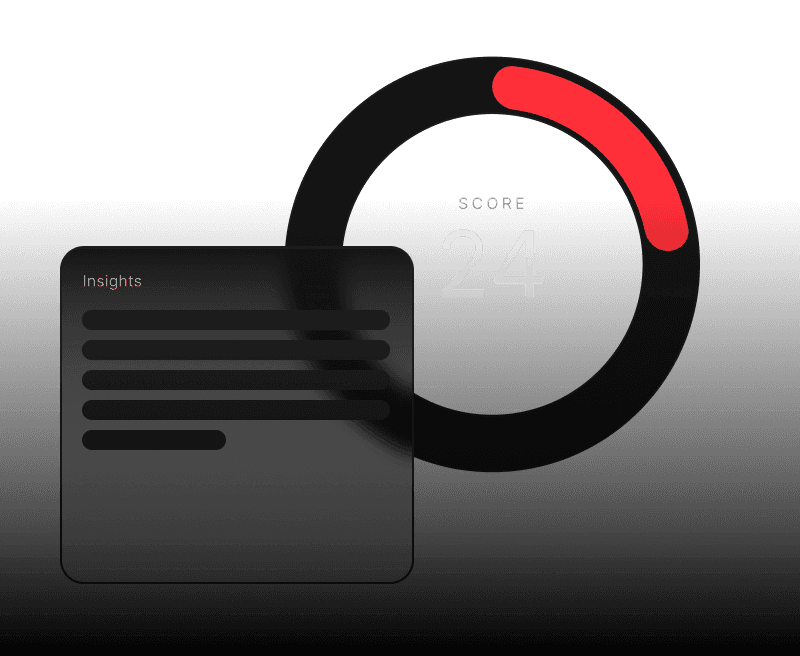
Explains itself.
Every score comes with the factors driving it: payment behavior, service history, tenure, contract timing, engagement. Your team knows why an account is flagged before they pick up the phone.

Handles the three ways customers actually leave:
Active cancellation, non-payment, and quiet inactivity. Most models only catch the first one.

Scores by service line,
so a customer at risk on one product and healthy on another shows up correctly instead of averaging out to nothing.
WHAT'S IN THE BOX
The engine is already built.

Every deployment ships with the same validated core:
A trained model architecture: gradient-boosted trees with calibrated probability output
A 53-feature framework across contract, payment, portfolio, service, support, and composite signals
The data intake and mapping layer, with automated readiness scoring
Monthly scoring pipeline with ranked output and reason codes
Performance monitoring and drift detection
Delivery into your CRM or retention workflow
What gets customized is your data, your churn definition, and your thresholds. Not the engine.
This is machine learning, not a chatbot.
Most AI vendors will sell you a large language model with a prompt behind it. That's the wrong tool for this job. Churn prediction is a statistics problem, and it has been solved with statistics for thirty years.
We use gradient-boosted decision trees with isotonic calibration, trained on your own history. It produces a calibrated probability, not a guess dressed up in a sentence.
The difference is that you can measure it. Ours reports:
0.91 ROC-AUC
in production, at scale
Ask any vendor selling you an "AI churn solution" for those three numbers. Most cannot produce them, because there is nothing underneath to measure.

The Proof
400,000 accounts, scored monthly, in production.
Massey Services, a top-5 US pest control operator, was losing subscription customers with no early warning. Their data lived in a SQL database with three years of history, four service lines, and the usual decade of accumulated mess.
We built and deployed their churn model in under 30 days. It scores roughly 400,000 active programs every month across a $500M+ subscription portfolio, ranking accounts by 90-day cancellation risk with the reasons attached.
$7.4M
in at-risk annual revenue identified
126x
return on the engagement
0.91
ROC-AUC in production

Three stages. The hard one is already done.
Stage 1

Your data in
We profile your data and score its readiness before anything gets built
AI maps your columns to the model's schema, and you confirm it
We derive what's missing and engineer the signals the model needs
Stage 2

Your model trained
Trained on your history, tuned to your business and each service line
Calibrated so a 70% score means 70%, with thresholds set to your team's capacity
Validated against your own churn outcomes before it goes live
Stage 3

Running and maintained
Scores your whole book monthly and routes the at-risk list to the right owner
Monitors itself for drift and retrains on a schedule as your business changes
Feeds save outcomes back in, so it sharpens every cycle
What we need from you
What we need
Where it usually lives
Contract and lifecycle: start date, renewal date, plan, contract value
CRM or billing system
Account status: active, cancelled, cancellation date, products held
Billing system or CRM
Payment behavior: history, failed charges, amount changes
Billing or payments platform
Engagement: service visits, logins, usage, last activity
Operational system, varies by business
Support: tickets, complaints, sentiment where available
Help desk or CRM
Tenure: account creation or first subscription date
Billing or CRM
Missing pieces are often derivable. Renewal dates from start date plus billing interval. Payment delay from invoice and payment dates. Price sensitivity from historical invoice amounts. We tell you what's derived and what's direct, so you know which signals to trust.
We'll tell you if your data is ready before you commit to anything.
Every engagement starts with a data quality scan and a readiness score out of 100. It checks the things that actually break churn models: missing values, inconsistent date formats, duplicate accounts, whether a clean cancellation label exists, how far back the history goes, and whether you have the volume to train on.
Green: ready to run. Yellow: we can run it, with the limitations stated in the output. Red: we don't run it. You get a remediation checklist instead, and the model waits until the data can support it.
We would rather tell you no in week one than deliver a model nobody should trust.

WHO IT'S FOR
Subscription and recurring-revenue service businesses:
Pest Control
Lawn care
HVAC service plans
Alarm and monitoring
Waste and sanitation
Pool service
Managed IT
and any operator billing the same customers month after month.
It also works for SaaS and media subscription businesses. The contract, payment, and tenure signals are universal; the engagement signals get customized to how your customers actually show up.
FAQ
How do we know if we're a fit?
Six questions decide it. Do you run on recurring revenue? Do you have at least 2,000 active accounts? Do you know your current churn rate? Do you have at least six months of cancellation history, ideally twelve? Do you have operational data beyond billing, like service visits, support tickets, or usage? And is there a team that will actually work the list? If any answer is no, we'll tell you this isn't the right project yet.
How accurate is it?
In production, our deployed model reports 0.91 ROC-AUC, 70% precision, and 81% recall. In plain terms: when it flags an account as at risk, it's right about 7 times out of 10, and it catches about 8 of every 10 customers who actually leave.
Why not just use ChatGPT or an LLM for this?
Large language models predict text, not probabilities. Churn prediction needs a calibrated risk score you can rank and measure, which is what gradient-boosted trees do well and language models do poorly. We use the right tool, and the tradeoff is that you get numbers you can hold us to.
How long does it take?
The Massey deployment went from kickoff to production in under 30 days. Your timeline depends mostly on the state of your data, which is why we score it first.
How messy can our data be?
Messier than you think. The Massey deployment ran on three years of accumulated history across four service lines, with gaps and inconsistent structure. There is a floor, though: we need a reliable cancellation label, at least six months of history, and around 2,000 accounts.
Where does it run?
We host and run it, so there's nothing for your team to deploy or maintain. If your data can't leave your environment, we can deploy it into your cloud instead, which is how the Massey model runs today in their Azure environment.
What do we get each month?
A ranked list of at-risk accounts with probability scores, confidence levels, and the factors driving each score, delivered into the system your retention team already uses.
What does it cost?
Implementation is priced against the state of your data, and there's an ongoing subscription for scoring, monitoring, and retraining. We'll give you both numbers on a call once we know what we're working with.
What if our data isn't ready?
Then we tell you, and we give you the checklist to fix it. We don't take money for a model we don't believe will hold up.
In 30 minutes we'll look at what data you have, what it would take to score your book, and whether this is worth doing at all.