Understanding AI Value Creation in Legal & Closing Firms
Understanding AI Value Creation in Legal & Closing Firms

James Sullivan
James Sullivan
October 8, 2026
October 8, 2026

Most legal and closing firms aren't losing on AI tools. They're losing on the scoreboard: measuring activity while boards demand EBITDA.
Legal and closing firms are not losing the AI race because they picked the wrong tools. They are keeping score on the wrong board. The common assumption among CEOs, founders, and business owners is that AI value is measured in features shipped, pilots launched, and productivity impressions, and that the board will eventually connect the dots to revenue.
Across the industry, firms have layered in chatbots, document-review software, and workflow platforms, yet when the board asks what that spend returned, the room goes quiet. The problem is a measurement gap that was baked in from day one.

That gap is structural. Understanding it is the first job of any honest AI transformation consulting conversation. See our AI transformation consulting for how this works in practice. According to a March 2026 analysis tracked by DoTadda, AI spending across enterprises has reached 3.3% of revenue, with 80% of that spend sitting outside IT budgets entirely. When spend is diffuse across operations, HR, and individual practice groups, no single owner is accountable for the return. Budget gets allocated. Vendors get paid. And at quarter-end, no one can reconcile the outlay to a line on the income statement.
3%
of revenue
The Goldman Sachs CIO Survey from June 2026 found that two-thirds of AI investments are funded through budget reallocation rather than fresh spending. That mechanism makes the ownership problem worse. When AI is funded by quietly cannibalizing existing line items, there is no clean before-and-after comparison. The spend disappears into the organization, and so does any hope of tracing it to EBITDA.
Consider the inbound call problem alone. A closing firm fielding realtor inquiries, wire-confirmation requests, and status checks can miss a substantial share of calls during peak hours. Each missed call is a file, and the revenue attached to it, redirected to a competitor who picked up. Agentic voice AI addresses exactly this failure point without adding headcount, but the value only registers on the P&L if someone is measuring call-to-file conversion before and after deployment. Most firms are not. Features and pilots are activity metrics.
Boards fund outcomes. Firms that track the wrong outputs will keep arriving at board meetings with decks full of utilization statistics and leaving without capital commitment or strategic confidence. The measurement crisis is solvable, and solving it starts with agreeing on what AI value creation actually means in a firm where every dollar of removed operating cost flows directly to EBITDA.
Key takeaways
Most legal and closing firms are measuring AI on the wrong scoreboard, counting pilots launched and documents automated instead of EBITDA moved.
Every $1 of operating cost AI removes is $1 of EBITDA, which translates to roughly $5 of enterprise value. That math is the only metric a CFO or board should accept as proof.
Only 10% of AI value comes from the algorithm itself. Seventy percent comes from people, process redesign, and change management, meaning most firms are overspending on software and underspending on the work that actually moves margin.
Sixty percent of title files still pass through eight or more human touchpoints before clear-to-close. Bolting AI onto that workflow produces micro-productivity, not margin. The leverage is in eliminating the handoffs, not accelerating them.
Three out of four AI pilots never reach production, not because the model fails, but because pilots are evaluated on activity metrics instead of documented EBITDA contribution, so no one ever builds the financial case to replace the old process.
OneSeven Tech closes that gap by working with operationally heavy mid-market legal and closing firms to translate excess operating expenses into measurable EBITDA, starting with the math before any tool gets selected.
What AI Value Creation Actually Means for Operationally Heavy Firms
For operationally heavy firms, AI investment tends to produce visible activity long before it produces a defensible financial outcome, and that gap is where transformation initiatives quietly stall. What follows breaks down how those three sources of value actually interact, where the accountability gap surfaces in practice, and what an engagement model designed around documented EBITDA improvement looks like instead.

The Three Sources of AI Value Creation and How They Hit the P&L
Research on AI adoption in financial services consistently points to three reinforcing sources of AI business value: speed, cost reduction, and productivity. Speed without cost reduction produces faster work at the same margin. Teams, and their portfolio company employees, invest real effort in value creation initiatives, throughput climbs modestly, and yet the cost-per-file barely moves. OneSeven Tech's engagement model is built to close that gap: the Fractional Chief AI Officer (CAIO) function exists specifically to reorient AI initiatives away from activity metrics and toward the documented P&L outcomes that boards and buyers actually score.
The EBITDA Equation - Why Every Dollar of Operating Cost Removed Is Worth Five Dollars of Enterprise Value
The math is direct. according to industry data analysis of lower middle market transactions, buyers underwrite value at EBITDA multiples in the 3x to 6x range for operationally intensive firms in this segment, a range further contextualized by Auxo Capital Advisors in their review of how acquirers select between EBITDA and revenue valuation frameworks. That means every $1 of operating cost removed by AI is $1 of EBITDA, which translates to $3 to $6 of enterprise value at exit.
A closing firm with 40 closers carrying $1,200 in avoidable labor cost per file, closing 5,000 files per year, is sitting on $6 million in annual OpEx exposure. A 10% reduction in cost-per-file is not a productivity win. 6 million in enterprise value at a 6x multiple. OneSeven Tech's AI Readiness Assessment is the starting point for establishing that scoreboard: it baselines current operational costs, identifies which workflows carry the highest avoidable cost concentration, and maps those directly to the P&L before a single line of implementation work begins.
The Four Value Dimensions That Actually Matter in Legal and Closing Firms
The four dimensions that replace it are: speed to close, cost per file, call-handling capacity, and compliance accuracy. OneSeven Tech's Forward-Deployed Engineering model and Agentic Voice AI capability address call-handling capacity directly, deploying voice AI into inbound realtor workflows to absorb volume without proportional headcount growth.
The Dealsuite UK&I M&A Monitor reinforces why this distinction has grown urgent: buyer scrutiny of operational efficiency in transaction-intensive businesses has intensified, and firms that can demonstrate documented unit-cost improvement carry a measurable valuation premium over those presenting only throughput narratives.
What Is the Difference Between Using AI on Existing Work Versus Redesigning Work Around AI
Sixty percent of title files still pass through eight or more human touchpoints before reaching clear-to-close.

Bolt-On AI Produces Micro-Productivity Not Margin
Using AI on top of an unchanged workflow is the equivalent of installing a faster printer in a process that prints too many pages. The output accelerates slightly; the cost structure does not move. BCG (Boston Consulting Group) research confirms that companies capturing transformational AI value eliminated or restructured existing steps entirely, compressing cycle times and reducing the human touches per file rather than making each touch marginally faster.
Take the most common bolt-on in title and closing: AI that auto-generates a HUD closing disclosure draft. A pattern we see repeatedly in firms we work with is that organizations deploy AI tools, agents, platforms, and full-featured products without redesigning the workflows around them.
The tool never gets the chance to free up team capacity for revenue-related work because the team was never asked to stop doing the work the old way. When organizations stay stuck in bolt-on mode, they deploy AI without changing decision rights, handoffs, or process ownership, so the underlying workflow is identical and the AI layer remains cosmetic rather than structural. Bolting AI onto existing workflows caps value at incremental levels and actively prevents the P&L signal from appearing at all, because the underlying cost structure and process ownership remain identical.
Redesigning Work Around AI Means Fewer Humans Touch Each File
Exception-flagging, document completeness checks, and compliance verification run without a human in the loop. A standalone wire-verification bot bolted onto an existing call queue saves a few minutes per call. OneSeven Tech's approach to AI implementation is structured to integrate with existing operations without ripping out what already works, mapping decision rights and file-handoff sequences before a single AI feature goes live, so the redesign is built into the deployment rather than attempted afterward.
The Gap Is Architectural Not Technological
OneSeven Tech's Fractional Chief AI Officer (CAIO) engagement addresses this directly, a forward-deployed resource whose explicit mandate is to map the architectural gaps between where AI sits today and where it needs to sit to show up as EBITDA.
What Percentage of AI Value Comes From Algorithms Versus People and Processes
According to industry research, only 10% of AI value comes from the algorithm itself, 20% from technology and data infrastructure, and 70% from people, process redesign, and change management. The synthesis claim that follows is this: because 70% of AI value is unlocked through people, process redesign, and change management rather than algorithms, firms that treat AI adoption as a technology procurement decision are misallocating roughly 90% of the effort budget that actually determines ROI, and for legal and closing firms specifically, that means the diagnostic question before any AI spend is not "which model?"

The 10/20/70 Split - Why the Algorithm Is the Smallest Variable in Your AI ROI
It is a resource allocation failure: the firm invested in the 10% and left the 70% unfunded. BCG's executive research confirms this pattern is the primary reason AI initiatives stall before they reach the P&L. That is precisely where OneSeven Tech's AI Readiness Assessment earns its place, not by recommending a tool, but by mapping which of your existing operational processes are structurally ready to be streamlined, and which organizational conditions must be built first before any software spend is justified.
AI Creates New Work, Not Just Less Work, Inside Title, Escrow, and Closing Roles
The risk is role ambiguity: staff whose job descriptions no longer match the work the firm actually needs done. Without that mandate sitting at the leadership level, the 70% remains aspirational. With it, process redesign has an owner and a deadline.
Sizing Your Change Management Investment Before Buying Software
And what is the retraining plan for the roles that shift? Firms that cannot answer all three are not ready to capture the 70%, regardless of which tool they select. That is where applied AI consulting structured around Forward-Deployed Engineering earns its place: not by selecting the algorithm, but by building the organizational architecture that lets the algorithm's value show up on the P&L instead of stranding inside a pilot dashboard.
The Core Pillars of an AI Value Creation Framework That Moves the P&L
Three out of four AI pilots never reach production, and the failure is almost never the model. The model works. The measurement doesn't. Because pilots are evaluated on activity metrics rather than documented EBITDA contribution, no one in the organization ever accumulates the financial evidence needed to justify replacing the old process. The pilot coexists with the status quo indefinitely, which is exactly how a closing firm ends up paying for both an AI subscription and the same labor cost it was supposed to eliminate (HackerNoon). The tool is the least consequential decision. What actually determines whether AI moves the P&L is three interlocking conditions, applied in sequence. Miss one, and the framework collapses into another detached IT line item.
1. Strategy Before Technology - Define the Friction Metric Before Selecting Any Model
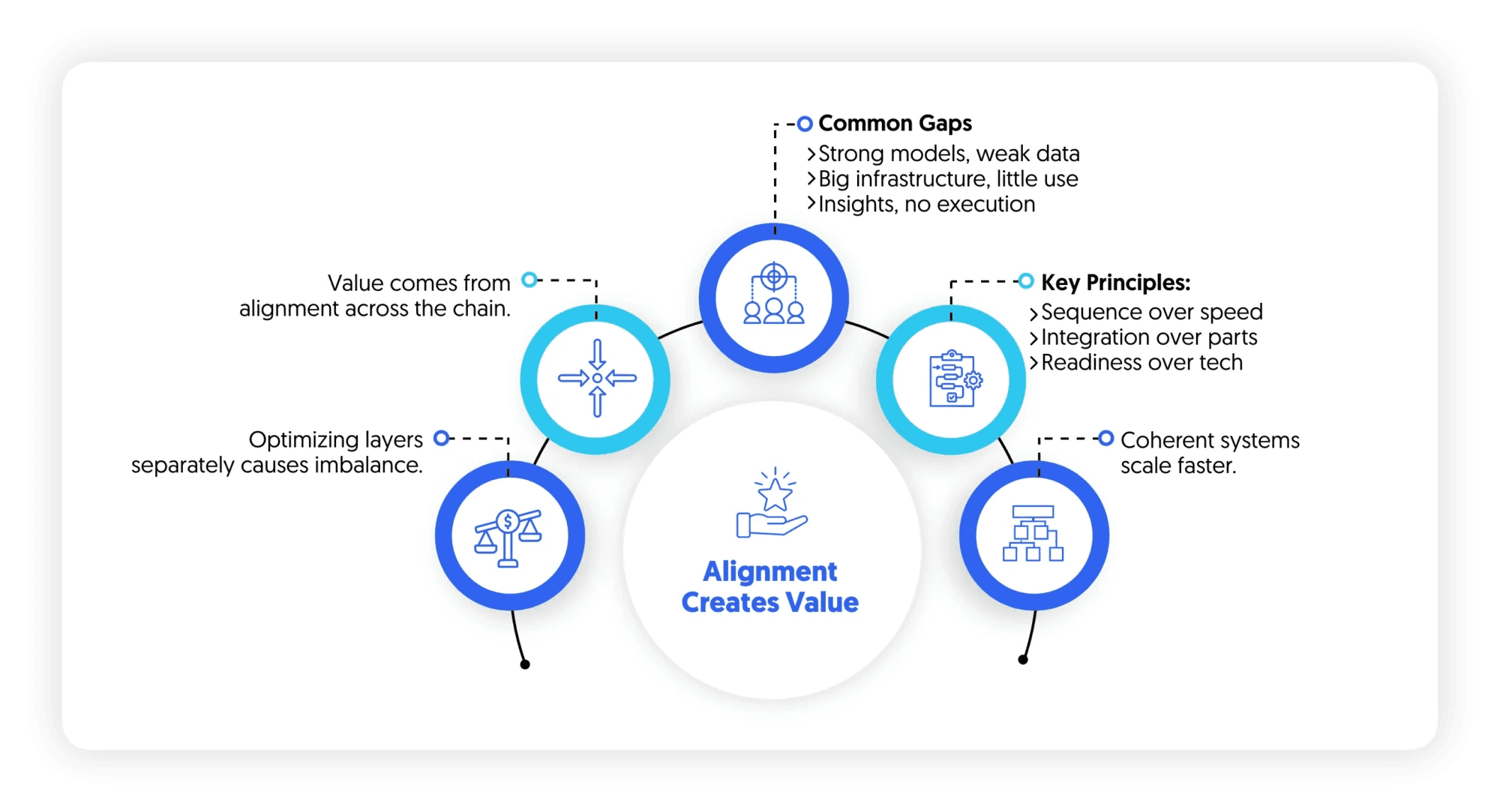
The core pillars of an AI value creation framework begin here: name a specific, measurable friction point before any vendor conversation starts. Across the market, 65% of firms lack a formal methodology for measuring AI success even after budgeting for it. A closing firm that defines a concrete cost-reduction target before evaluating any AI vendor filters every subsequent decision through a single financial target. Without that anchor, vendor selection becomes a feature comparison with no way to declare success or failure.
This is where OneSeven Tech's AI Readiness Assessment earns its place at the front of the engagement. Before any model selection or vendor conversation, the assessment surfaces the specific manual, repetitive workflows that are slowing team throughput and inflating headcount costs, the exact friction points that, once named, become the financial target every subsequent AI decision is measured against. For legal and closing firms that are designing for a new operational model or whose existing processes carry high friction in core user flows, the assessment is most beneficial precisely because it produces a defined use case before the build phase begins, not after.
2. Workflow Re-engineering - Redesigning Decision Rights for Human-AI Symbiotic Operation

Bolting AI onto an unredesigned workflow produces cosmetic efficiency. The McKinsey AI Transformation Framework explicitly requires redesigning operating models and reassigning decision rights, not just deploying tools into existing handoff structures. A title firm that scales a document AI pilot by first restructuring who owns AI-flagged exception items converts pilot KPIs directly into production metrics. The tradeoff: this step is slower and organizationally harder than any software deployment, and firms that skip it reliably produce shelfware.
Rather than handing off a specification and waiting, engineers work inside the client's operational context, which means the redesigned decision rights and handoff structures get stress-tested against real workflows, not hypothetical process maps. The goal is a scalable operational infrastructure that doesn't break as the company grows from 100 to 500+ employees, because workflow re-engineering that only holds at current headcount defers the collapse to a later, more expensive moment.
For firms that want executive alignment embedded in the operating model rather than bolted on afterward, OneSeven Tech's Fractional Chief AI Officer (CAIO) service provides the organizational authority to enforce redesigned decision rights across departments, the kind of executive sponsorship the BCG AI@Scale framework identifies as a prerequisite for generating returns that isolated pilots structurally cannot.
3. Rigorous KPI Tracking - Tying Every AI Deployment Directly to P&L Line Items
Operational KPIs only matter when they feed a financial KPI the board can read. Call-to-file conversion rate, cost per file, and days-to-close are the right instruments for legal and closing firms because each maps directly to labor cost and transaction margin. Bain's research found that nearly 40% of companies measuring AI cost savings landed below 10% despite targeting 11% to 20%, a gap that traces directly to KPI frameworks disconnected from finance reporting. Instrument the workflow before deployment, capture the post-AI delta, and route the result to the P&L owner, not the IT team (HackerNoon).
OneSeven Tech's Churn Prediction Model and AI/ML Development capabilities are most valuable here when the KPI framework is already in place, because embedding AI-powered capabilities into a new or existing digital product during the build phase, with a defined use case already scoped, is what converts post-AI deltas into evidence the board can act on rather than metrics that live only in an ops dashboard.
4. The Compounding Returns Mechanism - How the Three Pillars Create Durable AI Value Creation
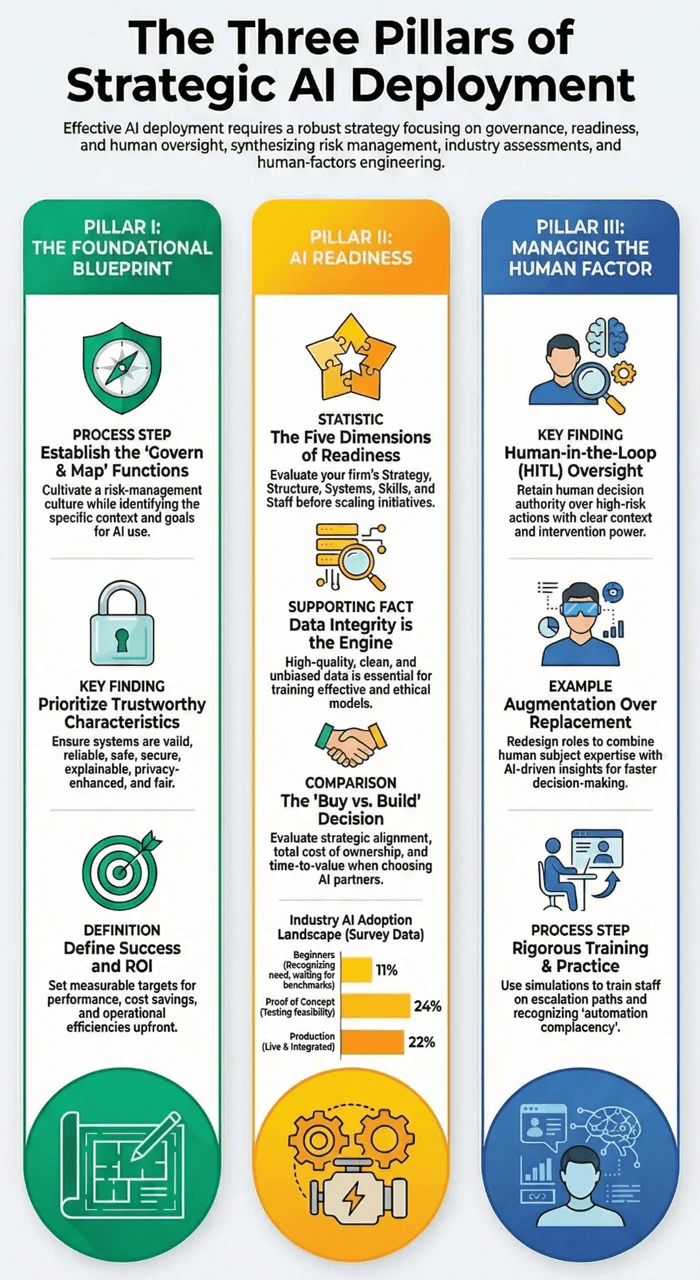
When strategy, workflow redesign, and KPI tracking operate together, AI value creation compounds: each deployment cycle produces cleaner data, tighter decision models, and faster throughput, which feeds the next cycle. ICONIQ's insurance AI analysis confirms that durable platforms are defined not by automation alone but by the outcomes they can observe and improve with every cycle. The tradeoff is time horizon, compounding returns require 12-to-24-month commitment before the flywheel effect becomes visible on the P&L.
Related Reading
Enterprise Ai Applications
Ai Implementation Best Practices
Ai Operational Efficiency
Ai Consulting Cost
Top Ai Consulting Firms
Ai Implementation Cost
Ai Implementation Partner
How Legal and Closing Firms Should Measure AI ROI and Which KPIs Actually Matter
"Small legal firms struggle to quantify ROI on the field because time savings from 'boring' high-frequency tasks (e.g. intake, document filing) are not formally tracked, making it hard to establish baseline KPIs."
— what we hear from small legal firms

Part of what makes this so common: small legal firms rarely formally track time spent on high-frequency, "boring" operational tasks, intake processing, document filing, title report summarization.
The Two-Tier KPI Hierarchy - Why Operational Metrics Are Inputs, Not Answers
A title firm tracking a raw count of AI-summarized reports has a Tier 1 number. A title firm tracking cost per report, monthly savings, and the annualized EBITDA impact of that reduction has a Tier 2 number. Demonstrating operational ROI to executive leadership and the board is a defined discipline, one that requires tracking OpEx removal at 30, 60, and 90 days post-deployment rather than waiting for a quarterly summary that no one can reconstruct.
The Spreadsheet Calculation - Converting Eliminated Labor Cost Into EBITDA and Enterprise Value
The multiplier matters enormously. At a 3x to 6x EBITDA valuation multiple common in this segment, a $50,000 annual OpEx reduction translates to $150,000 to $300,000 in enterprise value.
Instrumenting the Baseline Before Deployment So the Delta Is Board-Ready
Before any applied AI goes live, pull 90 days of operational data on the specific unit you intend to move: cost per file, cost per call resolved, or cost per exception cleared. Firms that engage OneSeven Tech's Fractional Chief AI Officer (CAIO) establish that baseline as a structured deliverable at engagement kickoff, not as an afterthought. The CAIO function owns the 30-, 60-, and 90-day OpEx removal measurement cadence, wires the post-AI delta into existing financial reporting, and ensures the EBITDA impact is visible and auditable before the board meeting, not reconstructed for one.
Why Execution Velocity Is the Missing Constraint in Capturing AI Value

Why AI Pilots Stall at the Threshold Between Proof and P&L
Datapro.news reporting on MIT AI enterprise research, drawing on findings surfaced by MIT Sloan Management Review and corroborated by Teneo AI, puts the scale-failure rate at 95%: only 5% of enterprise AI projects move from experimentation to production value, and the gap between those two states is rarely technical. The result is a pilot that looks like proof but functions like a dead end. Execution velocity is what separates the 5% from the rest: the rate at which a lean implementation team can drive workflow redesign decisions faster than the organization's default instinct to stall, re-route, or wait for internal consensus.
The Re-Hire Reflex - How It Kills AI ROI
Here is the specific mechanism that kills AI ROI in legal and closing firms, and the synthesis that most AI adoption frameworks miss entirely: firms that understand the 10/20/70 rule and still fail to capture AI value are losing to a single hidden constraint, the re-hire reflex, which moves faster than most implementation timelines. Because revenue growth historically tracks headcount growth, the organization's default response to increased throughput is to open a job requisition before the implementation has time to demonstrate that fewer people can handle the volume, effectively resetting the cost baseline before any efficiency gain can register on the P&L.
The window is shorter than most CEOs expect, and once a new hire is onboarded, the financial case for the AI investment becomes significantly harder to close. OneSeven Tech's AI Readiness Assessment is designed to surface this timing risk before deployment begins, mapping which workflows are ready to absorb AI at speed and where the re-hire reflex is most likely to fire.
Which Roles Survive and Which Evolve Based on Implementation Speed
Implementation speed determines whether processors evolve into judgment-focused roles or whether the organization simply adds headcount around the new tooling and preserves the old cost structure. Capabilities like Agentic Voice AI and the Company Brain accelerate this shift precisely because they replace repeatable, high-volume interaction patterns at the workflow level, not as bolt-on features, but as embedded replacements for the tasks that currently keep processors occupied with volume rather than judgment. Scaling AI beyond pilots requires that the pace of implementation outrun the organization's instinct to preserve the roles it already has, and that the embedded AI/ML capabilities are introduced during the product build phase, when a business is ready to integrate them into existing workflows, not after headcount decisions have already been made.
How OneSeven Tech Applies These AI Value Creation Principles in Legal and Closing Firms
Most legal and closing firm CEOs have absorbed at least one AI engagement that produced a polished roadmap and a handoff meeting, then went quiet. The board still asks the same question: where is it on the P&L? That gap between framework knowledge and captured EBITDA is a model problem, and the model is what has to change first.

The Math-First Mandate
AI transformation consulting built around a documented ROI calculation before a single line of code is written changes the fundamental economics of the engagement. Across the market, every AI project should begin with a documented ROI calculation before any technology is selected or built, and when the math does not support the investment, the right partner says so rather than proceeding to capture fees. That discipline kills low-return projects early, before budget is committed.
Take a concrete example. A closing firm identifies unanswered realtor calls as a friction point. Before any technology is selected, the calculation runs: calls missed per week, average transaction value attached to each relationship, revenue recovered per call answered. If the number does not clear the investment threshold, the project stops. That is not a consulting outcome. That is a financial gate.
EBITDA as the Only Scoreboard
According to Aidols Group (2025), removing $1 of operating expense produces $1 of EBITDA. For legal and closing firms where operating expenses routinely run above 60% of revenue, that multiplier is the board's actual question, expressed as arithmetic. ROI multiples have ranged from 4.4x to 126x across 150+ projects precisely because the scoreboard is set at the engagement's start, not retrofitted after delivery.
Partner Velocity vs. Consultant Cadence
A traditional consultant is accountable to a project plan. An AI implementation partner is accountable to the client's P&L. This distinction holds as a general principle: a true implementation partner co-owns outcomes and measures success against operating results, not a deliverable milestone checklist.
A Fractional Chief AI Officer changes the equation for mid-market firms by providing an embedded executive who owns the math, drives the 70% people-and-process work, and stays until the EBITDA moves. This model requires the CEO to share real P&L access and commit internal resources to process change; firms that want a low-touch engagement will not get full value from co-ownership.
Related Reading
How To Choose An Ai Consulting Firm
Ai Vendor Selection
Ai Use Cases For Business
Generative Ai Experts
How Long Does Ai Implementation Take
Top Ai Transformation Firms
Chief Ai Officer Responsibilities
Next steps
If your AI spend still has no clear line to the P&L when the board asks, the path forward starts with a documented cost-per-unit reduction traced directly to a specific EBITDA line before any vendor conversation begins.
Bolting AI onto existing workflows actively prevents the P&L signal from appearing at all, because the underlying cost structure and process ownership remain identical, which means the measurement problem is architectural, not technological. And because 70% of AI value is unlocked through people, process redesign, and change management rather than algorithms, firms that treat AI adoption as a technology procurement decision are misallocating roughly 90% of the effort budget that actually determines ROI. Together, those two realities point to a single next step: establish the financial baseline and the workflow ownership questions before any model is selected or any implementation begins.
Start with AI transformation consulting from OneSeven Tech to run the pre-technology ROI calculation that either justifies the investment or stops it before budget is committed. From there, the AI Readiness Assessment surfaces which workflows carry the highest avoidable cost concentration, maps them to a specific EBITDA line, and gives your board a defensible number rather than a productivity narrative.
Frequently Asked Questions
Why do AI pilots fail to scale into real business results?
Pilots fail to scale because they are measured on activity metrics, utilization, productivity impressions, features shipped, rather than documented P&L outcomes. When AI is bolted onto unchanged workflows without redesigning decision rights, handoffs, or process ownership, employees quietly revert to familiar methods, adoption stays cosmetic, and the cost structure never moves.
How do you actually quantify the cost-benefit of an AI investment in a closing firm?
The conversion runs through EBITDA: every dollar of operating cost removed by AI is one dollar of EBITDA, which translates to $3-$6 of enterprise value at the 3x–6x multiples buyers apply to operationally intensive lower-middle-market firms. A concrete example from the post: a closing firm with $1,200 in avoidable labor cost per file across 5,000 annual files carries $6 million in annual OpEx exposure, so a 10% cost-per-file reduction is a $600,000 EBITDA event worth up to $3.6 million in enterprise value at a 6x multiple.
How do I identify which processes in my firm are the right ones to target with AI first?
The post points to four dimensions with a direct line to the P&L as the right starting filter: speed to close, cost per file, call-handling capacity, and compliance accuracy. Baselining current operational costs and identifying which workflows carry the highest avoidable cost concentration, before any implementation work begins, is the method the post describes for establishing that scoreboard.
If 70% of AI value comes from people and process, why do most firms spend most of their budget on software?
The post frames this as a capital allocation decision hiding in plain sight: firms treat AI adoption as a technology procurement exercise and under-invest in the people, process redesign, and change management layer that actually unlocks the majority of the value. Because AI spend is often diffuse across operations, HR, and individual practice groups with no single accountable owner, no one is positioned to force the organizational redesign that converts the tool into a documented financial outcome.
What's the difference between an AI readiness evaluation and just buying an AI tool and seeing what happens?
An AI readiness evaluation baselines current operational costs, identifies which workflows carry the highest avoidable cost concentration, and maps those directly to the P&L before a single line of implementation work begins. Buying a tool without that foundation means the workflow architecture, not the technology, remains the constraint, which is precisely the pattern that produces a board room full of utilization statistics and no defensible EBITDA story.
Most legal and closing firms aren't losing on AI tools. They're losing on the scoreboard: measuring activity while boards demand EBITDA.
Legal and closing firms are not losing the AI race because they picked the wrong tools. They are keeping score on the wrong board. The common assumption among CEOs, founders, and business owners is that AI value is measured in features shipped, pilots launched, and productivity impressions, and that the board will eventually connect the dots to revenue.
Across the industry, firms have layered in chatbots, document-review software, and workflow platforms, yet when the board asks what that spend returned, the room goes quiet. The problem is a measurement gap that was baked in from day one.
That gap is structural. Understanding it is the first job of any honest AI transformation consulting conversation. See our AI transformation consulting for how this works in practice. According to a March 2026 analysis tracked by DoTadda, AI spending across enterprises has reached 3.3% of revenue, with 80% of that spend sitting outside IT budgets entirely. When spend is diffuse across operations, HR, and individual practice groups, no single owner is accountable for the return. Budget gets allocated. Vendors get paid. And at quarter-end, no one can reconcile the outlay to a line on the income statement.
3%
of revenue
The Goldman Sachs CIO Survey from June 2026 found that two-thirds of AI investments are funded through budget reallocation rather than fresh spending. That mechanism makes the ownership problem worse. When AI is funded by quietly cannibalizing existing line items, there is no clean before-and-after comparison. The spend disappears into the organization, and so does any hope of tracing it to EBITDA.
Consider the inbound call problem alone. A closing firm fielding realtor inquiries, wire-confirmation requests, and status checks can miss a substantial share of calls during peak hours. Each missed call is a file, and the revenue attached to it, redirected to a competitor who picked up. Agentic voice AI addresses exactly this failure point without adding headcount, but the value only registers on the P&L if someone is measuring call-to-file conversion before and after deployment. Most firms are not. Features and pilots are activity metrics.
Boards fund outcomes. Firms that track the wrong outputs will keep arriving at board meetings with decks full of utilization statistics and leaving without capital commitment or strategic confidence. The measurement crisis is solvable, and solving it starts with agreeing on what AI value creation actually means in a firm where every dollar of removed operating cost flows directly to EBITDA.
Key takeaways
Most legal and closing firms are measuring AI on the wrong scoreboard, counting pilots launched and documents automated instead of EBITDA moved.
Every $1 of operating cost AI removes is $1 of EBITDA, which translates to roughly $5 of enterprise value. That math is the only metric a CFO or board should accept as proof.
Only 10% of AI value comes from the algorithm itself. Seventy percent comes from people, process redesign, and change management, meaning most firms are overspending on software and underspending on the work that actually moves margin.
Sixty percent of title files still pass through eight or more human touchpoints before clear-to-close. Bolting AI onto that workflow produces micro-productivity, not margin. The leverage is in eliminating the handoffs, not accelerating them.
Three out of four AI pilots never reach production, not because the model fails, but because pilots are evaluated on activity metrics instead of documented EBITDA contribution, so no one ever builds the financial case to replace the old process.
OneSeven Tech closes that gap by working with operationally heavy mid-market legal and closing firms to translate excess operating expenses into measurable EBITDA, starting with the math before any tool gets selected.
What AI Value Creation Actually Means for Operationally Heavy Firms
For operationally heavy firms, AI investment tends to produce visible activity long before it produces a defensible financial outcome, and that gap is where transformation initiatives quietly stall. What follows breaks down how those three sources of value actually interact, where the accountability gap surfaces in practice, and what an engagement model designed around documented EBITDA improvement looks like instead.
The Three Sources of AI Value Creation and How They Hit the P&L
Research on AI adoption in financial services consistently points to three reinforcing sources of AI business value: speed, cost reduction, and productivity. Speed without cost reduction produces faster work at the same margin. Teams, and their portfolio company employees, invest real effort in value creation initiatives, throughput climbs modestly, and yet the cost-per-file barely moves. OneSeven Tech's engagement model is built to close that gap: the Fractional Chief AI Officer (CAIO) function exists specifically to reorient AI initiatives away from activity metrics and toward the documented P&L outcomes that boards and buyers actually score.
The EBITDA Equation - Why Every Dollar of Operating Cost Removed Is Worth Five Dollars of Enterprise Value
The math is direct. according to industry data analysis of lower middle market transactions, buyers underwrite value at EBITDA multiples in the 3x to 6x range for operationally intensive firms in this segment, a range further contextualized by Auxo Capital Advisors in their review of how acquirers select between EBITDA and revenue valuation frameworks. That means every $1 of operating cost removed by AI is $1 of EBITDA, which translates to $3 to $6 of enterprise value at exit.
A closing firm with 40 closers carrying $1,200 in avoidable labor cost per file, closing 5,000 files per year, is sitting on $6 million in annual OpEx exposure. A 10% reduction in cost-per-file is not a productivity win. 6 million in enterprise value at a 6x multiple. OneSeven Tech's AI Readiness Assessment is the starting point for establishing that scoreboard: it baselines current operational costs, identifies which workflows carry the highest avoidable cost concentration, and maps those directly to the P&L before a single line of implementation work begins.
The Four Value Dimensions That Actually Matter in Legal and Closing Firms
The four dimensions that replace it are: speed to close, cost per file, call-handling capacity, and compliance accuracy. OneSeven Tech's Forward-Deployed Engineering model and Agentic Voice AI capability address call-handling capacity directly, deploying voice AI into inbound realtor workflows to absorb volume without proportional headcount growth.
The Dealsuite UK&I M&A Monitor reinforces why this distinction has grown urgent: buyer scrutiny of operational efficiency in transaction-intensive businesses has intensified, and firms that can demonstrate documented unit-cost improvement carry a measurable valuation premium over those presenting only throughput narratives.
What Is the Difference Between Using AI on Existing Work Versus Redesigning Work Around AI
Sixty percent of title files still pass through eight or more human touchpoints before reaching clear-to-close.
Bolt-On AI Produces Micro-Productivity Not Margin
Using AI on top of an unchanged workflow is the equivalent of installing a faster printer in a process that prints too many pages. The output accelerates slightly; the cost structure does not move. BCG (Boston Consulting Group) research confirms that companies capturing transformational AI value eliminated or restructured existing steps entirely, compressing cycle times and reducing the human touches per file rather than making each touch marginally faster.
Take the most common bolt-on in title and closing: AI that auto-generates a HUD closing disclosure draft. A pattern we see repeatedly in firms we work with is that organizations deploy AI tools, agents, platforms, and full-featured products without redesigning the workflows around them.
The tool never gets the chance to free up team capacity for revenue-related work because the team was never asked to stop doing the work the old way. When organizations stay stuck in bolt-on mode, they deploy AI without changing decision rights, handoffs, or process ownership, so the underlying workflow is identical and the AI layer remains cosmetic rather than structural. Bolting AI onto existing workflows caps value at incremental levels and actively prevents the P&L signal from appearing at all, because the underlying cost structure and process ownership remain identical.
Redesigning Work Around AI Means Fewer Humans Touch Each File
Exception-flagging, document completeness checks, and compliance verification run without a human in the loop. A standalone wire-verification bot bolted onto an existing call queue saves a few minutes per call. OneSeven Tech's approach to AI implementation is structured to integrate with existing operations without ripping out what already works, mapping decision rights and file-handoff sequences before a single AI feature goes live, so the redesign is built into the deployment rather than attempted afterward.
The Gap Is Architectural Not Technological
OneSeven Tech's Fractional Chief AI Officer (CAIO) engagement addresses this directly, a forward-deployed resource whose explicit mandate is to map the architectural gaps between where AI sits today and where it needs to sit to show up as EBITDA.
What Percentage of AI Value Comes From Algorithms Versus People and Processes
According to industry research, only 10% of AI value comes from the algorithm itself, 20% from technology and data infrastructure, and 70% from people, process redesign, and change management. The synthesis claim that follows is this: because 70% of AI value is unlocked through people, process redesign, and change management rather than algorithms, firms that treat AI adoption as a technology procurement decision are misallocating roughly 90% of the effort budget that actually determines ROI, and for legal and closing firms specifically, that means the diagnostic question before any AI spend is not "which model?"
The 10/20/70 Split - Why the Algorithm Is the Smallest Variable in Your AI ROI
It is a resource allocation failure: the firm invested in the 10% and left the 70% unfunded. BCG's executive research confirms this pattern is the primary reason AI initiatives stall before they reach the P&L. That is precisely where OneSeven Tech's AI Readiness Assessment earns its place, not by recommending a tool, but by mapping which of your existing operational processes are structurally ready to be streamlined, and which organizational conditions must be built first before any software spend is justified.
AI Creates New Work, Not Just Less Work, Inside Title, Escrow, and Closing Roles
The risk is role ambiguity: staff whose job descriptions no longer match the work the firm actually needs done. Without that mandate sitting at the leadership level, the 70% remains aspirational. With it, process redesign has an owner and a deadline.
Sizing Your Change Management Investment Before Buying Software
And what is the retraining plan for the roles that shift? Firms that cannot answer all three are not ready to capture the 70%, regardless of which tool they select. That is where applied AI consulting structured around Forward-Deployed Engineering earns its place: not by selecting the algorithm, but by building the organizational architecture that lets the algorithm's value show up on the P&L instead of stranding inside a pilot dashboard.
The Core Pillars of an AI Value Creation Framework That Moves the P&L
Three out of four AI pilots never reach production, and the failure is almost never the model. The model works. The measurement doesn't. Because pilots are evaluated on activity metrics rather than documented EBITDA contribution, no one in the organization ever accumulates the financial evidence needed to justify replacing the old process. The pilot coexists with the status quo indefinitely, which is exactly how a closing firm ends up paying for both an AI subscription and the same labor cost it was supposed to eliminate (HackerNoon). The tool is the least consequential decision. What actually determines whether AI moves the P&L is three interlocking conditions, applied in sequence. Miss one, and the framework collapses into another detached IT line item.
1. Strategy Before Technology - Define the Friction Metric Before Selecting Any Model
The core pillars of an AI value creation framework begin here: name a specific, measurable friction point before any vendor conversation starts. Across the market, 65% of firms lack a formal methodology for measuring AI success even after budgeting for it. A closing firm that defines a concrete cost-reduction target before evaluating any AI vendor filters every subsequent decision through a single financial target. Without that anchor, vendor selection becomes a feature comparison with no way to declare success or failure.
This is where OneSeven Tech's AI Readiness Assessment earns its place at the front of the engagement. Before any model selection or vendor conversation, the assessment surfaces the specific manual, repetitive workflows that are slowing team throughput and inflating headcount costs, the exact friction points that, once named, become the financial target every subsequent AI decision is measured against. For legal and closing firms that are designing for a new operational model or whose existing processes carry high friction in core user flows, the assessment is most beneficial precisely because it produces a defined use case before the build phase begins, not after.
2. Workflow Re-engineering - Redesigning Decision Rights for Human-AI Symbiotic Operation
Bolting AI onto an unredesigned workflow produces cosmetic efficiency. The McKinsey AI Transformation Framework explicitly requires redesigning operating models and reassigning decision rights, not just deploying tools into existing handoff structures. A title firm that scales a document AI pilot by first restructuring who owns AI-flagged exception items converts pilot KPIs directly into production metrics. The tradeoff: this step is slower and organizationally harder than any software deployment, and firms that skip it reliably produce shelfware.
Rather than handing off a specification and waiting, engineers work inside the client's operational context, which means the redesigned decision rights and handoff structures get stress-tested against real workflows, not hypothetical process maps. The goal is a scalable operational infrastructure that doesn't break as the company grows from 100 to 500+ employees, because workflow re-engineering that only holds at current headcount defers the collapse to a later, more expensive moment.
For firms that want executive alignment embedded in the operating model rather than bolted on afterward, OneSeven Tech's Fractional Chief AI Officer (CAIO) service provides the organizational authority to enforce redesigned decision rights across departments, the kind of executive sponsorship the BCG AI@Scale framework identifies as a prerequisite for generating returns that isolated pilots structurally cannot.
3. Rigorous KPI Tracking - Tying Every AI Deployment Directly to P&L Line Items
Operational KPIs only matter when they feed a financial KPI the board can read. Call-to-file conversion rate, cost per file, and days-to-close are the right instruments for legal and closing firms because each maps directly to labor cost and transaction margin. Bain's research found that nearly 40% of companies measuring AI cost savings landed below 10% despite targeting 11% to 20%, a gap that traces directly to KPI frameworks disconnected from finance reporting. Instrument the workflow before deployment, capture the post-AI delta, and route the result to the P&L owner, not the IT team (HackerNoon).
OneSeven Tech's Churn Prediction Model and AI/ML Development capabilities are most valuable here when the KPI framework is already in place, because embedding AI-powered capabilities into a new or existing digital product during the build phase, with a defined use case already scoped, is what converts post-AI deltas into evidence the board can act on rather than metrics that live only in an ops dashboard.
4. The Compounding Returns Mechanism - How the Three Pillars Create Durable AI Value Creation
When strategy, workflow redesign, and KPI tracking operate together, AI value creation compounds: each deployment cycle produces cleaner data, tighter decision models, and faster throughput, which feeds the next cycle. ICONIQ's insurance AI analysis confirms that durable platforms are defined not by automation alone but by the outcomes they can observe and improve with every cycle. The tradeoff is time horizon, compounding returns require 12-to-24-month commitment before the flywheel effect becomes visible on the P&L.
Related Reading
Enterprise Ai Applications
Ai Implementation Best Practices
Ai Operational Efficiency
Ai Consulting Cost
Top Ai Consulting Firms
Ai Implementation Cost
Ai Implementation Partner
How Legal and Closing Firms Should Measure AI ROI and Which KPIs Actually Matter
"Small legal firms struggle to quantify ROI on the field because time savings from 'boring' high-frequency tasks (e.g. intake, document filing) are not formally tracked, making it hard to establish baseline KPIs."
— what we hear from small legal firms
Part of what makes this so common: small legal firms rarely formally track time spent on high-frequency, "boring" operational tasks, intake processing, document filing, title report summarization.
The Two-Tier KPI Hierarchy - Why Operational Metrics Are Inputs, Not Answers
A title firm tracking a raw count of AI-summarized reports has a Tier 1 number. A title firm tracking cost per report, monthly savings, and the annualized EBITDA impact of that reduction has a Tier 2 number. Demonstrating operational ROI to executive leadership and the board is a defined discipline, one that requires tracking OpEx removal at 30, 60, and 90 days post-deployment rather than waiting for a quarterly summary that no one can reconstruct.
The Spreadsheet Calculation - Converting Eliminated Labor Cost Into EBITDA and Enterprise Value
The multiplier matters enormously. At a 3x to 6x EBITDA valuation multiple common in this segment, a $50,000 annual OpEx reduction translates to $150,000 to $300,000 in enterprise value.
Instrumenting the Baseline Before Deployment So the Delta Is Board-Ready
Before any applied AI goes live, pull 90 days of operational data on the specific unit you intend to move: cost per file, cost per call resolved, or cost per exception cleared. Firms that engage OneSeven Tech's Fractional Chief AI Officer (CAIO) establish that baseline as a structured deliverable at engagement kickoff, not as an afterthought. The CAIO function owns the 30-, 60-, and 90-day OpEx removal measurement cadence, wires the post-AI delta into existing financial reporting, and ensures the EBITDA impact is visible and auditable before the board meeting, not reconstructed for one.
Why Execution Velocity Is the Missing Constraint in Capturing AI Value
Why AI Pilots Stall at the Threshold Between Proof and P&L
Datapro.news reporting on MIT AI enterprise research, drawing on findings surfaced by MIT Sloan Management Review and corroborated by Teneo AI, puts the scale-failure rate at 95%: only 5% of enterprise AI projects move from experimentation to production value, and the gap between those two states is rarely technical. The result is a pilot that looks like proof but functions like a dead end. Execution velocity is what separates the 5% from the rest: the rate at which a lean implementation team can drive workflow redesign decisions faster than the organization's default instinct to stall, re-route, or wait for internal consensus.
The Re-Hire Reflex - How It Kills AI ROI
Here is the specific mechanism that kills AI ROI in legal and closing firms, and the synthesis that most AI adoption frameworks miss entirely: firms that understand the 10/20/70 rule and still fail to capture AI value are losing to a single hidden constraint, the re-hire reflex, which moves faster than most implementation timelines. Because revenue growth historically tracks headcount growth, the organization's default response to increased throughput is to open a job requisition before the implementation has time to demonstrate that fewer people can handle the volume, effectively resetting the cost baseline before any efficiency gain can register on the P&L.
The window is shorter than most CEOs expect, and once a new hire is onboarded, the financial case for the AI investment becomes significantly harder to close. OneSeven Tech's AI Readiness Assessment is designed to surface this timing risk before deployment begins, mapping which workflows are ready to absorb AI at speed and where the re-hire reflex is most likely to fire.
Which Roles Survive and Which Evolve Based on Implementation Speed
Implementation speed determines whether processors evolve into judgment-focused roles or whether the organization simply adds headcount around the new tooling and preserves the old cost structure. Capabilities like Agentic Voice AI and the Company Brain accelerate this shift precisely because they replace repeatable, high-volume interaction patterns at the workflow level, not as bolt-on features, but as embedded replacements for the tasks that currently keep processors occupied with volume rather than judgment. Scaling AI beyond pilots requires that the pace of implementation outrun the organization's instinct to preserve the roles it already has, and that the embedded AI/ML capabilities are introduced during the product build phase, when a business is ready to integrate them into existing workflows, not after headcount decisions have already been made.
How OneSeven Tech Applies These AI Value Creation Principles in Legal and Closing Firms
Most legal and closing firm CEOs have absorbed at least one AI engagement that produced a polished roadmap and a handoff meeting, then went quiet. The board still asks the same question: where is it on the P&L? That gap between framework knowledge and captured EBITDA is a model problem, and the model is what has to change first.
The Math-First Mandate
AI transformation consulting built around a documented ROI calculation before a single line of code is written changes the fundamental economics of the engagement. Across the market, every AI project should begin with a documented ROI calculation before any technology is selected or built, and when the math does not support the investment, the right partner says so rather than proceeding to capture fees. That discipline kills low-return projects early, before budget is committed.
Take a concrete example. A closing firm identifies unanswered realtor calls as a friction point. Before any technology is selected, the calculation runs: calls missed per week, average transaction value attached to each relationship, revenue recovered per call answered. If the number does not clear the investment threshold, the project stops. That is not a consulting outcome. That is a financial gate.
EBITDA as the Only Scoreboard
According to Aidols Group (2025), removing $1 of operating expense produces $1 of EBITDA. For legal and closing firms where operating expenses routinely run above 60% of revenue, that multiplier is the board's actual question, expressed as arithmetic. ROI multiples have ranged from 4.4x to 126x across 150+ projects precisely because the scoreboard is set at the engagement's start, not retrofitted after delivery.
Partner Velocity vs. Consultant Cadence
A traditional consultant is accountable to a project plan. An AI implementation partner is accountable to the client's P&L. This distinction holds as a general principle: a true implementation partner co-owns outcomes and measures success against operating results, not a deliverable milestone checklist.
A Fractional Chief AI Officer changes the equation for mid-market firms by providing an embedded executive who owns the math, drives the 70% people-and-process work, and stays until the EBITDA moves. This model requires the CEO to share real P&L access and commit internal resources to process change; firms that want a low-touch engagement will not get full value from co-ownership.
Related Reading
How To Choose An Ai Consulting Firm
Ai Vendor Selection
Ai Use Cases For Business
Generative Ai Experts
How Long Does Ai Implementation Take
Top Ai Transformation Firms
Chief Ai Officer Responsibilities
Next steps
If your AI spend still has no clear line to the P&L when the board asks, the path forward starts with a documented cost-per-unit reduction traced directly to a specific EBITDA line before any vendor conversation begins.
Bolting AI onto existing workflows actively prevents the P&L signal from appearing at all, because the underlying cost structure and process ownership remain identical, which means the measurement problem is architectural, not technological. And because 70% of AI value is unlocked through people, process redesign, and change management rather than algorithms, firms that treat AI adoption as a technology procurement decision are misallocating roughly 90% of the effort budget that actually determines ROI. Together, those two realities point to a single next step: establish the financial baseline and the workflow ownership questions before any model is selected or any implementation begins.
Start with AI transformation consulting from OneSeven Tech to run the pre-technology ROI calculation that either justifies the investment or stops it before budget is committed. From there, the AI Readiness Assessment surfaces which workflows carry the highest avoidable cost concentration, maps them to a specific EBITDA line, and gives your board a defensible number rather than a productivity narrative.
Frequently Asked Questions
Why do AI pilots fail to scale into real business results?
Pilots fail to scale because they are measured on activity metrics, utilization, productivity impressions, features shipped, rather than documented P&L outcomes. When AI is bolted onto unchanged workflows without redesigning decision rights, handoffs, or process ownership, employees quietly revert to familiar methods, adoption stays cosmetic, and the cost structure never moves.
How do you actually quantify the cost-benefit of an AI investment in a closing firm?
The conversion runs through EBITDA: every dollar of operating cost removed by AI is one dollar of EBITDA, which translates to $3-$6 of enterprise value at the 3x–6x multiples buyers apply to operationally intensive lower-middle-market firms. A concrete example from the post: a closing firm with $1,200 in avoidable labor cost per file across 5,000 annual files carries $6 million in annual OpEx exposure, so a 10% cost-per-file reduction is a $600,000 EBITDA event worth up to $3.6 million in enterprise value at a 6x multiple.
How do I identify which processes in my firm are the right ones to target with AI first?
The post points to four dimensions with a direct line to the P&L as the right starting filter: speed to close, cost per file, call-handling capacity, and compliance accuracy. Baselining current operational costs and identifying which workflows carry the highest avoidable cost concentration, before any implementation work begins, is the method the post describes for establishing that scoreboard.
If 70% of AI value comes from people and process, why do most firms spend most of their budget on software?
The post frames this as a capital allocation decision hiding in plain sight: firms treat AI adoption as a technology procurement exercise and under-invest in the people, process redesign, and change management layer that actually unlocks the majority of the value. Because AI spend is often diffuse across operations, HR, and individual practice groups with no single accountable owner, no one is positioned to force the organizational redesign that converts the tool into a documented financial outcome.
What's the difference between an AI readiness evaluation and just buying an AI tool and seeing what happens?
An AI readiness evaluation baselines current operational costs, identifies which workflows carry the highest avoidable cost concentration, and maps those directly to the P&L before a single line of implementation work begins. Buying a tool without that foundation means the workflow architecture, not the technology, remains the constraint, which is precisely the pattern that produces a board room full of utilization statistics and no defensible EBITDA story.
Ready to Build Industry Changing Software?
Ready to Build Industry Changing Software?
Ready to Build Industry Changing Software?
Click the button below, tell us more about your project and book a discovery call with our CEO.
Click the button below, tell us more about your project and book a discovery call with our CEO.