Chief AI Officer Responsibilities: Role, Scope, and Impact
Chief AI Officer Responsibilities: Role, Scope, and Impact

James Sullivan
James Sullivan

Boards are already asking the AI accountability question. Here is what the executive role built to answer it actually owns, and how it gets measured.
Boards are not asking CEOs about AI out of curiosity. They are asking because AI has become a financial accountability question, and right now most mid-market executives are sitting in that meeting with no credible answer to give. The applied AI operators who have closed that gap fastest share one thing in common: a dedicated C-suite owner of AI strategy who is measured in dollars, not deliverables.
The Chief AI Officer (CAIO) is a C-suite executive accountable for enterprise AI strategy, governance, implementation, risk management, and value creation across the organization. That definition matters because the role is frequently misread. Most chief executive officers and owner-operators assume that hiring a Chief AI Officer is an expensive leap of faith that requires waiting for a formal executive search, onboarding, and a multi-year runway before any financial return materializes.

In practice, the mandate is operational: convert AI investment into P&L outcomes, govern its risk, and drive adoption across business units. If the person holding the title is not accountable to EBITDA, the company does not have a Chief AI Officer. It has a keynote speaker on payroll.
If the person holding the title is not accountable to EBITDA, the company does not have a Chief AI Officer. It has a keynote speaker on payroll.
Demand for Chief AI Officers is growing because AI is transitioning from an IT project into a P&L lever, and boards and investors are now directly questioning CEOs about their AI leadership and roadmap credibility. The accountability gap this creates is structural. When AI lived inside the IT budget, the CTO absorbed the questions. Now that AI touches pricing, labor cost, customer retention, and revenue forecasting, no single existing C-suite role owns all of it.
The CAIO role emerged to close that gap with a named executive who answers for outcomes, not experiments. That executive owns five interlocking domains, each with a distinct mandate:
AI strategy, building and prioritizing a multi-year roadmap tied to business transformation, not a list of tools to evaluate.
Governance, setting the policies, controls, and compliance posture that keep the organization legally and reputationally safe as AI scales.
Implementation, driving adoption across business units, not handing off a prototype to an operations team and walking away.
Risk management, owning the exposure: model bias, data integrity, vendor accountability, and regulatory change.
Value creation, closing the loop between AI spend and measurable financial return.
Most mid-market operators handle this by distributing AI responsibility across the CTO, an operations lead, and whoever ran the last vendor evaluation. The hidden cost is the absence of a single person accountable for turning AI spend into documented EBITDA improvement.
OneSeven Tech's Fractional CAIO model is designed to close that gap within 30 days. Ancore Partners' 2024 analysis documents that embedded senior AI leadership can be operational with direct financial accountability in that window, compared to the 6-to-12-month search timeline Alliance Recruitment Agency's 2026 data confirms for full-time C-suite hires. Actual timelines depend on organizational readiness and the availability of operational workflow data to act on from day one.
6-to-12-month Typical full-time C-suite AI hire timeline
The next section maps the CAIO's core responsibility categories and the measurable output each one is expected to produce.
Key takeaways
The Chief AI Officer role is a financial accountability function, if the person in it isn't measured against P&L outcomes, the company has a strategy consultant with a C-suite title.
Six responsibility categories define the CAIO mandate: AI strategy, governance, C-suite partnership, technical deployment, talent development, and ROI measurement, each one tied to a direct business output.
The EU AI Act and NIST AI RMF are not future compliance considerations; for any company operating in or selling into EU markets, they are current operational obligations that require a dedicated executive to manage.
The median time to positive documented ROI from an AI investment is 14 months, which means every month without an accountable AI leader is a month of compounding delay, not a month of saved salary.
The majority of AI projects fail to deliver intended outcomes, and the single most common cause is the absence of a C-suite owner who bridges technical teams, business units, and executive leadership simultaneously.
Hiring the wrong CAIO doesn't just slow adoption, it typically costs 12 to 18 months of runway while a credential-heavy but operationally thin leader produces roadmaps instead of deployed workflows.
OneSeven Tech's Fractional Chief AI Officer is an embedded executive placed inside the client organization to own AI transformation, build and deploy workflows, and measure results against EBITDA, operational from day one, without the 14-month full-time hiring cycle.
The Six Core Responsibility Categories of a Chief AI Officer
Six core responsibility categories define the Chief AI Officer's mandate, and each one carries a direct, measurable business output. According to ZDNet's October 2024 analysis, the CAIO serves as the bridge between technical engineering teams, business units, and executive leadership to drive enterprise-wide AI strategy. The common assumption is that this role is primarily technical, measured in projects shipped and experiments run. Any CAIO whose six categories aren't wired to revenue, cost, or enterprise value is functioning as an internal consultant with a better title.
The critical structural flaw most organizations miss: slotting the CAIO under the CTO buries financial accountability inside a technology reporting line. When that happens, AI activity gets measured in shipped features rather than recovered margin. The role only generates P&L value when it reports with direct CFO accountability from day one.
CAIO Responsibility Checklist - Six Categories and Their Measurable Outputs
Responsibility Category | Primary Owner Action | Measurable Output |
Strategic AI Roadmap Development | Build multi-year roadmap tied to business transformation | High-impact use cases prioritized; low-ROI experiments eliminated |
Governance and Risk Management | Establish policy, controls, and compliance posture | Auditable frameworks; documented regulatory alignment |
Vendor Evaluation and Technology Stack Oversight | Build and audit AI vendor pipeline | Vendor scorecards; lock-in risk assessment complete |
AI Talent Recruitment and Team Leadership | Own build-vs-buy talent tradeoff and AI-augmented role re-evaluation | Staffing plan with retention, upskilling, and compensation alignment metrics |
Board and Investor Communication | Translate AI activity into financial narratives | Board-ready EBITDA-linked AI reporting cadence |
AI Value Creation and P&L Accountability | Track OpEx-to-EBITDA conversion by workflow | Documented dollar return according to industry data initiative |
Most mid-market companies handle this by distributing these responsibilities across the CTO, an IT director, and an outside consultant, hoping the sum adds up. The hidden cost is that no single person is accountable to the P&L outcome, so AI spending accumulates without a financial owner. OneSeven Tech's embedded execution model places a Fractional CAIO inside the organization with P&L-linked deliverables across all six categories from day one, replacing the "we'll hire eventually" posture with documented EBITDA return inside 30 days.
That engagement pairs directly with OneSeven Tech's Forward-Deployed Engineering and AI/ML Development capabilities, most effective when a business has a defined use case and an existing or new digital product to integrate AI into, so the CAIO isn't operating on strategy decks alone but on live implementation cycles. The trade-off is real: a fractional engagement works best when the organization has identifiable, high-OpEx workflows to target; it is not the right fit for companies still in early-stage strategy without operational data to act on. An AI Readiness Assessment is the appropriate entry point for organizations that haven't yet surfaced those workflows.
Each of these six categories carries its own execution risk, but none carries higher regulatory and reputational exposure than governance and compliance, where the rules are tightening faster than most enterprises are moving. The next section maps exactly which AI regulatory frameworks a CAIO must operationalize today, and why the organizations treating compliance as competitive infrastructure are pulling ahead of those still treating it as legal defense.
1. Strategic AI Roadmap Development - Charting the Multi-Year Enterprise AI Vision

Strategic leadership means developing a multi-year enterprise AI roadmap aligned with business transformation and growth goals, not a list of interesting experiments. CDO Times' March 2025 research identifies prioritizing high-impact use cases while filtering out low-ROI technology experiments as a core CAIO duty. A CAIO at a logistics company, for example, would deprioritize a customer chatbot in favor of invoice automation when the labor cost reduction math is 10 times larger. Filtering is the job.
2. Governance and Risk Management - Building the Enterprise AI Compliance and Ethics Framework

Governance determines whether AI outputs can be trusted, audited, and defended to regulators and insurers. The CAIO owns the frameworks that prevent data poisoning, model bias, and legal exposure from generative AI outputs. This category has the highest reputational downside of the six if left unstructured.
3. Cross-Functional C-Suite Partnership - Bridging Engineering, Business Units, and the Board

The CAIO serves as the connective tissue between technical engineering teams, business units, and executive leadership, a structural role that ZDNet's October that same figure analysis identifies as central to driving enterprise-wide AI strategy. Without this function, AI initiatives stall at the handoff between the team that builds and the team that decides. The measurable output here is cycle time: how fast does an AI use case move from validated concept to workflow deployment with full executive alignment behind it.
4. Vendor Evaluation and Technology Stack Oversight - Selecting and Governing the Enterprise AI Toolchain

The CAIO builds and audits the AI vendor pipeline, evaluating third-party platforms and large language model providers against performance, security, and architectural lock-in risk. Switching costs deepen as AI infrastructure scales, making early vendor decisions disproportionately expensive to reverse. This is a function that requires genuine technical fluency to assess what lives inside the stack.
5. AI Talent Recruitment and Team Leadership - Building and Retaining the Enterprise AI Organization

Demand for machine learning engineers and AI researchers significantly outpaces supply, making the build-vs-buy tradeoff on talent one of the CAIO's most consequential decisions. Internal upskilling preserves institutional knowledge but takes time; external hiring is faster but expensive and retention-fragile. The CAIO owns this tradeoff explicitly, not HR.
There is a compounding workforce tension that rarely surfaces in job descriptions but is one of the most urgent challenges organizations face once AI is embedded: employees whose output multiplies, from one times to five times productivity, in many documented cases, without a corresponding adjustment in compensation or role definition. That gap erodes morale and accelerates voluntary attrition precisely among the highest-performing people who have learned to work alongside AI effectively. A CAIO who treats talent responsibility as purely a recruiting function misses half the mandate.
Workforce compensation strategy and AI-augmented role re-evaluation belong inside this category, not delegated to HR after the fact. The CAIO must build the framework that connects productivity-gain data to role reclassification and compensation review cycles, or the talent pipeline drains from the inside.
6. Board and Investor Communication - Translating AI Strategy Into Business Value for Stakeholders

The CAIO translates complex AI activity into financial narratives that board members and investors can evaluate. This is a structural accountability function. Salesforce's analysis, covered by ZDNet, reinforces that CEOs increasingly need a credible internal voice who can connect AI investment to documented EBITDA outcomes, not just innovation optics.
AI Governance and Regulatory Frameworks Every CAIO Must Operationalize
The EU AI Act and NIST AI Risk Management Framework now impose concrete, deadline-driven obligations that require a dedicated executive function to operationalize, and how well that function is built determines whether AI deployments move through legal review quickly or stall.

The EU AI Act and NIST AI RMF Are the CAIO's Operational Baseline
Deployers across the AI Compass tiers, including SMEs, must address prohibited-practices screening, AI literacy documentation, and Article 50 disclosure obligations, with provision-specific application dates that cannot be deferred. Organizations that pre-map LLM deployments to NIST AI RMF controls before legal review consistently report substantially shorter sign-off cycles, because a well-governed deployment arrives with the documentation attorneys would otherwise spend weeks assembling.
Data Poisoning, Model Bias, and Generative AI Copyright as the CAIO's Technical Threat Surface
Data poisoning, model bias, and generative AI copyright exposure are active operational liabilities the CAIO must monitor and mitigate continuously. Model bias carries documented financial consequences in regulated industries, and without a dedicated owner tracking model drift and disparate-impact metrics, those consequences surface first in enforcement actions rather than internal audits. Generative AI copyright risk sits in a different category entirely, one where training data provenance and output indemnification terms vary sharply by vendor and use case, making pre-deployment contractual review a core CAIO responsibility.
Governance as Deployment Velocity
Governance, structured correctly, becomes a speed advantage. Organizations that build compliance scaffolding before deployment do not move slowly; they move once, without the six-week legal review that stalls every high-stakes use case at the point of executive sign-off. For companies embedding AI-powered capabilities into a new or existing digital product, this is where OneSeven Tech's model matters most.
Which C-Suite Roles the CAIO Partners With and Why Each Collaboration Matters
The CAIO's five C-suite partnerships are not calendar obligations. Each one is a financial lever, and when any one of them breaks down, AI initiatives stall in pilot purgatory regardless of how good the underlying model is. Softobiz data consistently finds that the majority of AI projects fail to deliver their intended outcomes, most often because of poor data quality, misaligned stakeholder expectations, and absent governance, the exact gaps these partnerships are designed to close.
"Aspiring CAIOs feel pressure to 'de-risk' their technical profile for Boards and C-suite peers, implying that technical credibility alone is insufficient for cross-functional executive partnerships."
— what we hear from aspiring C-suite AI executives
1. CAIO - CIO Partnership - Modernizing IT Infrastructure for AI Workloads

Among the most critical Chief AI Officer responsibilities is co-owning the technology stack with the CIO. The CAIO identifies where legacy infrastructure creates AI deployment bottlenecks, compute, latency, integration layers, while the CIO controls procurement and operations. Together they prioritize GPU clusters, cloud migration, and MLOps pipelines. The tradeoff: without clear ownership boundaries, both roles can stall on budget authority and vendor selection.
2. CAIO - CDO and CFO/CRO Collaboration - Data Provenance, ROI Quantification, and Structural Risk

The CAIO partners with the CDO to enforce data lineage, quality standards, and provenance frameworks that make AI outputs auditable and trustworthy. Simultaneously, the CAIO works with the CFO to translate model performance into financial return metrics and with the CRO to map AI failure modes onto enterprise risk registers. The limitation: these three simultaneous relationships demand exceptional stakeholder management bandwidth from a single executive.
3. CAIO Reporting Structure - CEO vs. CTO - How Organizational Design Shapes AI Authority
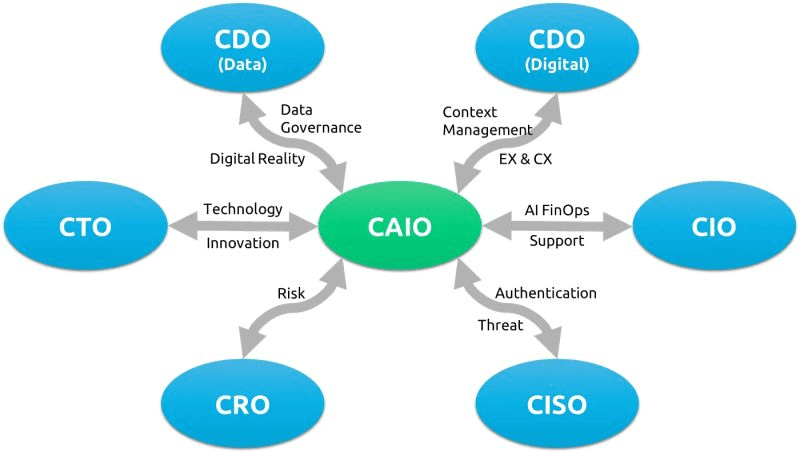
Where the CAIO sits in the org chart shapes the scope of every partnership above it. Olakai notes that the CAIO typically reports to the CEO when AI is treated as a company-wide strategic priority, or to the CTO when AI is scoped as a technology capability. The CEO reporting line gives the CAIO cross-functional authority to hold the CFO, CDO, and CIO accountable to shared AI outcomes. The CTO reporting line is faster to establish but narrows the mandate, often reducing the CAIO to a technical coordinator rather than a P&L-accountable executive. OneSeven Tech's AI Readiness Assessment surfaces this structural question early, mapping the existing org design against the AI mandate before a CAIO engagement is scoped, so reporting lines are resolved as a precondition of the work rather than a recurring source of friction inside it.
4. CAIO vs. CTO, CDO, and CIO - Defining the Boundaries of Each Role

Confusion between the CAIO and adjacent C-suite roles is one of the most common organizational design failures. The CTO owns product and engineering architecture; the CDO governs data assets and analytics; the CIO manages enterprise IT operations. The CAIO uniquely owns the cross-functional AI strategy, governance frameworks, and ethical deployment standards that cut across all three domains. The tradeoff: without explicit charter documents, role overlap with the CTO and CDO creates political friction that slows AI adoption.
5. CAIO as Board Translator - Converting Algorithmic Complexity into Business Impact Narratives

Boards are not equipped to evaluate model architecture. A core CAIO responsibility is distilling complex algorithmic outputs into capital-allocation narratives that non-technical executives can act on. Olakai identifies this board communication function as central to the role, not a soft skill layered on top of it.
The pressure aspiring CAIOs face here is real: technical credibility alone is insufficient for cross-functional executive partnerships. Professionals moving into CAIO roles who lead with model performance metrics, precision scores, F1, AUC, without translating them into margin or retention outcomes lose the room before the budget conversation begins. The CAIO who connects a precision score to a margin outcome is the one who unlocks budget.
OneSeven Tech's Company Brain capability speaks directly to this translation layer: it converts the outputs of live AI/ML systems into structured, queryable business intelligence that non-technical executives can interrogate on their own terms, reducing the CAIO's translation burden in recurring board interactions and making AI impact legible without requiring a technical interpreter in the room.
Most mid-market companies assume they need a fully staffed C-suite before these partnerships can generate real financial returns. In practice, the embedded model works in reverse: a Fractional CAIO placed inside the existing org maps live relationships with whoever currently owns IT, data, and finance, then begins converting those relationships into documented EBITDA impact, with no org redesign required. OneSeven Tech is most beneficial in this context when a business has a defined use case for AI/ML and an existing or new digital product to integrate it into, and when it needs a team that can operate as integrated roles, a mini-managed team, or a fully managed team depending on what the org can absorb.
The AI/ML Development and Agentic Voice AI capabilities are scoped to the product build phase precisely because that is when embedded execution, not advisory, closes the gap between a funded initiative and a shipped one.
Understanding who the CAIO partners with clarifies the organizational wiring, but it raises an equally important question: what does the person filling that role actually need to know and be able to do? The skills and technical competencies required to execute across all five of these partnerships are more specific, and more demanding, than most job descriptions reveal.
Related Reading
Required Skills and Technical Competencies for a Chief AI Officer
The required skills for a Chief AI Officer are a specific combination of deployment history, technical fluency, and commercial judgment that only accumulates through years of building real systems under real business pressure.

The Technical Fluency Floor
A CAIO must personally understand machine learning pipelines, agentic AI architectures, foundation model tuning, data lineage practices, and cloud-scale AI infrastructure at a depth that makes it impossible for a vendor or internal engineer to obscure a problem with jargon. That depth matters most in agentic AI contexts, where autonomous systems make sequential decisions with limited human checkpoints.
Experience Over Credentials
At the executive level, the experiential track record routinely outweighs the credential in hiring decisions.
Vendor Judgment as a Core Competency
Once this function is formalized, a core responsibility of the role is establishing rigorous processes to evaluate, select, and audit third-party AI platforms and LLM providers. An effective vendor evaluation process covers at minimum: model provenance and training data transparency, data residency and lineage controls, contractual protections around model output ownership, and the vendor's own incident response posture.
Chief AI Officer Compensation Benchmarks Boards Need to Know Before Budgeting
A board that treats Chief AI Officer compensation as a salary benchmarking exercise is making a $1.5 million mistake before the first interview is scheduled. Understanding why requires looking at what the full compensation stack actually contains.

What the Full Compensation Stack Actually Looks Like by Company Tier
Chief AI Officer base salaries run $259,000 to $650,000+ depending on company scale and sector. At enterprise tech companies and frontier AI labs, total CAIO compensation reaches $1,500,000 to $3,000,000+ once equity grants and performance bonuses are included. Outside frontier tech, operationally heavy industries such as financial services, healthcare, and manufacturing typically land closer to $300,000 to $450,000 in base with more modest equity structures. The base figure, however, is rarely the whole story. A job posting showing $380,000 base can carry another $200,000 to $600,000 in annual equity vesting, sign-on grants, and milestone bonuses once the full offer is assembled.
How to Calculate Your CAIO Return Threshold Before the Board Meeting
The return threshold calculation must account for the full ramp period, not just the headline salary. A full-time CAIO hire at $300,000 base plus equity can consume $300,000 to $600,000 or more in total payroll before AI investments reach positive documented returns, a window that IDC research benchmarks at a median of 14 months. This is precisely the pressure OneSeven Tech's AI Readiness Assessment is designed to resolve before a hire is made, giving boards a documented return threshold to evaluate against any compensation structure under consideration.
The Fractional Cost Wedge for Mid-Market Budget Decisions
Embedded fractional CAIO engagements typically run in the range of $10,000 to $25,000 per month depending on scope and time commitment. They deliver applied AI leadership with P&L accountability from day one, with fixed-cost exposure that is lower than a full-time executive package when the mandate is defined and time-bounded. Against a full-time package of $400,000 to $650,000 in annual base alone, that is a cost wedge of $280,000 to $530,000 in year one, before equity is counted. That wedge widens further when the engagement is scoped around specific deliverables.
Full-Time CAIO vs Fractional CAIO - The Decision Framework Boards Actually Want
The decision looks straightforward until the numbers are laid out: CEOs walk in debating salary ranges and equity percentages when the decision turns on three variables: the duration of the AI mandate, the internal capability gap, and the revenue leverage attached to each month of execution speed. Each of those variables points toward a different hiring structure, and ignoring them produces the wrong answer regardless of budget.
On accountability, what most teams report is direct: organizations that hire a Chief AI Officer without tying the role to P&L outcomes or EBITDA targets are paying for a strategic advisory function with no financial feedback loop.

On readiness, most mid-market operators do not have the data infrastructure or internal AI fluency required to absorb a full-time CAIO, so that six-figure hire spends their first year building organizational prerequisites rather than converting OpEx to EBITDA. That dynamic makes the hiring model itself a readiness question, not just a cost question.
The fractional CAIO model is structurally better matched to mid-market AI maturity than a full-time hire. Most mid-market organizations lack the data infrastructure and internal AI fluency required to absorb a full-time executive, which means the full-time hire delays transformation by spending the first year building the organizational readiness a fractional engagement would have created at a fraction of the cost.
How P&L Accountability Defines the CAIO Role Versus an Advisory Function
The distinction between a CAIO and a strategic advisor collapses quickly once financial accountability enters the conversation. The test is simple: ask any CAIO candidate, full-time or fractional, to name the EBITDA target they will be held to in the first 90 days. A candidate who answers in workflows or milestones is telling you something important about which function they are prepared to perform.
Consider what this looks like in practice. In engagements scoped to financial targets rather than deliverable lists, fractional CAIO models have produced documented annualized OpEx reductions that give boards a concrete return baseline before committing to a full-time hire, turning the first 90 days into a proof-of-concept for the investment rather than a prolonged onboarding period. That outcome was measurable because the engagement was scoped to a financial target, not a deliverable list.
The Cost-of-Delay Calculation Every Board Should Run Before Posting a CAIO Job
The average time-to-fill for a C-suite role runs 6 to 12 months, accounting for search, interview cycles, offer negotiation, and notice periods, so EBITDA impact is zero for the better part of a year. Set that against a fractional model that, as broader market experience documents, can embed senior AI leadership within 30 days with direct accountability to measurable financial outcomes from day one.
Related Reading
How To Choose An Ai Consulting Firm
Ai Vendor Selection
Ai Use Cases For Business
Generative Ai Experts
How Long Does Ai Implementation Take
Top Ai Transformation Firms
Next steps
If your AI budget is producing activity metrics instead of P&L outcomes, the path forward starts with measuring AI in dollars before deciding who owns the mandate. Start with our AI transformation consulting.
The finding that slotting a CAIO under the CTO buries financial accountability inside a technology reporting line means most organizations are currently measuring the wrong things by design, not by accident. The finding that a full-time hire at even the low end of the salary range consumes $300,000 to $600,000 in payroll before the organization statistically reaches breakeven means the hire-versus-not-hire debate is already costing money while it runs. Together, they point to one action: establish a documented EBITDA baseline before the search opens, not after.
Start with OneSeven's embedded Fractional CAIO model, which places a P&L-accountable AI leader inside your operations within 30 days. From there, existing workflows are audited against documented return, high-OpEx use cases are prioritized, and your board gets a defensible EBITDA number, not a roadmap deck.
Frequently Asked Questions
Why are so many companies suddenly hiring a Chief AI Officer?
AI has shifted from an IT project into a P&L lever, and boards and investors are now directly questioning CEOs about their AI leadership and roadmap credibility. Because AI now touches pricing, labor cost, customer retention, and revenue forecasting, no single existing C-suite role owns all of it, the CAIO role emerged to close that accountability gap with a named executive who answers for outcomes, not experiments.
Who should the Chief AI Officer report to, the CTO or the CFO?
The post is clear that slotting the CAIO under the CTO buries financial accountability inside a technology reporting line, where AI activity gets measured in shipped features rather than recovered margin. The role only generates P&L value when it reports with direct CFO accountability from day one.
What does a Chief AI Officer actually own day-to-day?
The CAIO owns six interlocking responsibility categories: strategic AI roadmap development, governance and risk management, vendor evaluation and technology stack oversight, AI talent recruitment and team leadership, board and investor communication, and AI value creation with P&L accountability. Each category is expected to produce a measurable business output, not just projects or deliverables.
What EU AI Act obligations does a CAIO need to operationalize?
The CAIO must operationalize the EU AI Act, which categorizes AI systems by risk level, unacceptable, high, limited, and minimal, each carrying distinct, ongoing governance obligations. This includes prohibited-practices screening, AI literacy documentation, and Article 50 disclosure obligations, and it pairs with the NIST AI Risk Management Framework to translate legal requirements into auditable internal controls.
Does a company really have to do a full executive search to get a Chief AI Officer in place?
Not necessarily, the post notes that a full-time C-suite search typically takes 6 to 12 months, but an embedded senior AI leader can be operational with direct financial accountability within 30 days. OneSeven Tech's Fractional CAIO model is specifically designed to close that gap, placing a CAIO inside the organization with P&L-linked deliverables from day one.
Boards are already asking the AI accountability question. Here is what the executive role built to answer it actually owns, and how it gets measured.
Boards are not asking CEOs about AI out of curiosity. They are asking because AI has become a financial accountability question, and right now most mid-market executives are sitting in that meeting with no credible answer to give. The applied AI operators who have closed that gap fastest share one thing in common: a dedicated C-suite owner of AI strategy who is measured in dollars, not deliverables.
The Chief AI Officer (CAIO) is a C-suite executive accountable for enterprise AI strategy, governance, implementation, risk management, and value creation across the organization. That definition matters because the role is frequently misread. Most chief executive officers and owner-operators assume that hiring a Chief AI Officer is an expensive leap of faith that requires waiting for a formal executive search, onboarding, and a multi-year runway before any financial return materializes.
In practice, the mandate is operational: convert AI investment into P&L outcomes, govern its risk, and drive adoption across business units. If the person holding the title is not accountable to EBITDA, the company does not have a Chief AI Officer. It has a keynote speaker on payroll.
If the person holding the title is not accountable to EBITDA, the company does not have a Chief AI Officer. It has a keynote speaker on payroll.
Demand for Chief AI Officers is growing because AI is transitioning from an IT project into a P&L lever, and boards and investors are now directly questioning CEOs about their AI leadership and roadmap credibility. The accountability gap this creates is structural. When AI lived inside the IT budget, the CTO absorbed the questions. Now that AI touches pricing, labor cost, customer retention, and revenue forecasting, no single existing C-suite role owns all of it.
The CAIO role emerged to close that gap with a named executive who answers for outcomes, not experiments. That executive owns five interlocking domains, each with a distinct mandate:
AI strategy, building and prioritizing a multi-year roadmap tied to business transformation, not a list of tools to evaluate.
Governance, setting the policies, controls, and compliance posture that keep the organization legally and reputationally safe as AI scales.
Implementation, driving adoption across business units, not handing off a prototype to an operations team and walking away.
Risk management, owning the exposure: model bias, data integrity, vendor accountability, and regulatory change.
Value creation, closing the loop between AI spend and measurable financial return.
Most mid-market operators handle this by distributing AI responsibility across the CTO, an operations lead, and whoever ran the last vendor evaluation. The hidden cost is the absence of a single person accountable for turning AI spend into documented EBITDA improvement.
OneSeven Tech's Fractional CAIO model is designed to close that gap within 30 days. Ancore Partners' 2024 analysis documents that embedded senior AI leadership can be operational with direct financial accountability in that window, compared to the 6-to-12-month search timeline Alliance Recruitment Agency's 2026 data confirms for full-time C-suite hires. Actual timelines depend on organizational readiness and the availability of operational workflow data to act on from day one.
6-to-12-month Typical full-time C-suite AI hire timeline
The next section maps the CAIO's core responsibility categories and the measurable output each one is expected to produce.
Key takeaways
The Chief AI Officer role is a financial accountability function, if the person in it isn't measured against P&L outcomes, the company has a strategy consultant with a C-suite title.
Six responsibility categories define the CAIO mandate: AI strategy, governance, C-suite partnership, technical deployment, talent development, and ROI measurement, each one tied to a direct business output.
The EU AI Act and NIST AI RMF are not future compliance considerations; for any company operating in or selling into EU markets, they are current operational obligations that require a dedicated executive to manage.
The median time to positive documented ROI from an AI investment is 14 months, which means every month without an accountable AI leader is a month of compounding delay, not a month of saved salary.
The majority of AI projects fail to deliver intended outcomes, and the single most common cause is the absence of a C-suite owner who bridges technical teams, business units, and executive leadership simultaneously.
Hiring the wrong CAIO doesn't just slow adoption, it typically costs 12 to 18 months of runway while a credential-heavy but operationally thin leader produces roadmaps instead of deployed workflows.
OneSeven Tech's Fractional Chief AI Officer is an embedded executive placed inside the client organization to own AI transformation, build and deploy workflows, and measure results against EBITDA, operational from day one, without the 14-month full-time hiring cycle.
The Six Core Responsibility Categories of a Chief AI Officer
Six core responsibility categories define the Chief AI Officer's mandate, and each one carries a direct, measurable business output. According to ZDNet's October 2024 analysis, the CAIO serves as the bridge between technical engineering teams, business units, and executive leadership to drive enterprise-wide AI strategy. The common assumption is that this role is primarily technical, measured in projects shipped and experiments run. Any CAIO whose six categories aren't wired to revenue, cost, or enterprise value is functioning as an internal consultant with a better title.
The critical structural flaw most organizations miss: slotting the CAIO under the CTO buries financial accountability inside a technology reporting line. When that happens, AI activity gets measured in shipped features rather than recovered margin. The role only generates P&L value when it reports with direct CFO accountability from day one.
CAIO Responsibility Checklist - Six Categories and Their Measurable Outputs
Responsibility Category | Primary Owner Action | Measurable Output |
Strategic AI Roadmap Development | Build multi-year roadmap tied to business transformation | High-impact use cases prioritized; low-ROI experiments eliminated |
Governance and Risk Management | Establish policy, controls, and compliance posture | Auditable frameworks; documented regulatory alignment |
Vendor Evaluation and Technology Stack Oversight | Build and audit AI vendor pipeline | Vendor scorecards; lock-in risk assessment complete |
AI Talent Recruitment and Team Leadership | Own build-vs-buy talent tradeoff and AI-augmented role re-evaluation | Staffing plan with retention, upskilling, and compensation alignment metrics |
Board and Investor Communication | Translate AI activity into financial narratives | Board-ready EBITDA-linked AI reporting cadence |
AI Value Creation and P&L Accountability | Track OpEx-to-EBITDA conversion by workflow | Documented dollar return according to industry data initiative |
Most mid-market companies handle this by distributing these responsibilities across the CTO, an IT director, and an outside consultant, hoping the sum adds up. The hidden cost is that no single person is accountable to the P&L outcome, so AI spending accumulates without a financial owner. OneSeven Tech's embedded execution model places a Fractional CAIO inside the organization with P&L-linked deliverables across all six categories from day one, replacing the "we'll hire eventually" posture with documented EBITDA return inside 30 days.
That engagement pairs directly with OneSeven Tech's Forward-Deployed Engineering and AI/ML Development capabilities, most effective when a business has a defined use case and an existing or new digital product to integrate AI into, so the CAIO isn't operating on strategy decks alone but on live implementation cycles. The trade-off is real: a fractional engagement works best when the organization has identifiable, high-OpEx workflows to target; it is not the right fit for companies still in early-stage strategy without operational data to act on. An AI Readiness Assessment is the appropriate entry point for organizations that haven't yet surfaced those workflows.
Each of these six categories carries its own execution risk, but none carries higher regulatory and reputational exposure than governance and compliance, where the rules are tightening faster than most enterprises are moving. The next section maps exactly which AI regulatory frameworks a CAIO must operationalize today, and why the organizations treating compliance as competitive infrastructure are pulling ahead of those still treating it as legal defense.
1. Strategic AI Roadmap Development - Charting the Multi-Year Enterprise AI Vision
Strategic leadership means developing a multi-year enterprise AI roadmap aligned with business transformation and growth goals, not a list of interesting experiments. CDO Times' March 2025 research identifies prioritizing high-impact use cases while filtering out low-ROI technology experiments as a core CAIO duty. A CAIO at a logistics company, for example, would deprioritize a customer chatbot in favor of invoice automation when the labor cost reduction math is 10 times larger. Filtering is the job.
2. Governance and Risk Management - Building the Enterprise AI Compliance and Ethics Framework
Governance determines whether AI outputs can be trusted, audited, and defended to regulators and insurers. The CAIO owns the frameworks that prevent data poisoning, model bias, and legal exposure from generative AI outputs. This category has the highest reputational downside of the six if left unstructured.
3. Cross-Functional C-Suite Partnership - Bridging Engineering, Business Units, and the Board
The CAIO serves as the connective tissue between technical engineering teams, business units, and executive leadership, a structural role that ZDNet's October that same figure analysis identifies as central to driving enterprise-wide AI strategy. Without this function, AI initiatives stall at the handoff between the team that builds and the team that decides. The measurable output here is cycle time: how fast does an AI use case move from validated concept to workflow deployment with full executive alignment behind it.
4. Vendor Evaluation and Technology Stack Oversight - Selecting and Governing the Enterprise AI Toolchain
The CAIO builds and audits the AI vendor pipeline, evaluating third-party platforms and large language model providers against performance, security, and architectural lock-in risk. Switching costs deepen as AI infrastructure scales, making early vendor decisions disproportionately expensive to reverse. This is a function that requires genuine technical fluency to assess what lives inside the stack.
5. AI Talent Recruitment and Team Leadership - Building and Retaining the Enterprise AI Organization
Demand for machine learning engineers and AI researchers significantly outpaces supply, making the build-vs-buy tradeoff on talent one of the CAIO's most consequential decisions. Internal upskilling preserves institutional knowledge but takes time; external hiring is faster but expensive and retention-fragile. The CAIO owns this tradeoff explicitly, not HR.
There is a compounding workforce tension that rarely surfaces in job descriptions but is one of the most urgent challenges organizations face once AI is embedded: employees whose output multiplies, from one times to five times productivity, in many documented cases, without a corresponding adjustment in compensation or role definition. That gap erodes morale and accelerates voluntary attrition precisely among the highest-performing people who have learned to work alongside AI effectively. A CAIO who treats talent responsibility as purely a recruiting function misses half the mandate.
Workforce compensation strategy and AI-augmented role re-evaluation belong inside this category, not delegated to HR after the fact. The CAIO must build the framework that connects productivity-gain data to role reclassification and compensation review cycles, or the talent pipeline drains from the inside.
6. Board and Investor Communication - Translating AI Strategy Into Business Value for Stakeholders
The CAIO translates complex AI activity into financial narratives that board members and investors can evaluate. This is a structural accountability function. Salesforce's analysis, covered by ZDNet, reinforces that CEOs increasingly need a credible internal voice who can connect AI investment to documented EBITDA outcomes, not just innovation optics.
AI Governance and Regulatory Frameworks Every CAIO Must Operationalize
The EU AI Act and NIST AI Risk Management Framework now impose concrete, deadline-driven obligations that require a dedicated executive function to operationalize, and how well that function is built determines whether AI deployments move through legal review quickly or stall.
The EU AI Act and NIST AI RMF Are the CAIO's Operational Baseline
Deployers across the AI Compass tiers, including SMEs, must address prohibited-practices screening, AI literacy documentation, and Article 50 disclosure obligations, with provision-specific application dates that cannot be deferred. Organizations that pre-map LLM deployments to NIST AI RMF controls before legal review consistently report substantially shorter sign-off cycles, because a well-governed deployment arrives with the documentation attorneys would otherwise spend weeks assembling.
Data Poisoning, Model Bias, and Generative AI Copyright as the CAIO's Technical Threat Surface
Data poisoning, model bias, and generative AI copyright exposure are active operational liabilities the CAIO must monitor and mitigate continuously. Model bias carries documented financial consequences in regulated industries, and without a dedicated owner tracking model drift and disparate-impact metrics, those consequences surface first in enforcement actions rather than internal audits. Generative AI copyright risk sits in a different category entirely, one where training data provenance and output indemnification terms vary sharply by vendor and use case, making pre-deployment contractual review a core CAIO responsibility.
Governance as Deployment Velocity
Governance, structured correctly, becomes a speed advantage. Organizations that build compliance scaffolding before deployment do not move slowly; they move once, without the six-week legal review that stalls every high-stakes use case at the point of executive sign-off. For companies embedding AI-powered capabilities into a new or existing digital product, this is where OneSeven Tech's model matters most.
Which C-Suite Roles the CAIO Partners With and Why Each Collaboration Matters
The CAIO's five C-suite partnerships are not calendar obligations. Each one is a financial lever, and when any one of them breaks down, AI initiatives stall in pilot purgatory regardless of how good the underlying model is. Softobiz data consistently finds that the majority of AI projects fail to deliver their intended outcomes, most often because of poor data quality, misaligned stakeholder expectations, and absent governance, the exact gaps these partnerships are designed to close.
"Aspiring CAIOs feel pressure to 'de-risk' their technical profile for Boards and C-suite peers, implying that technical credibility alone is insufficient for cross-functional executive partnerships."
— what we hear from aspiring C-suite AI executives
1. CAIO - CIO Partnership - Modernizing IT Infrastructure for AI Workloads
Among the most critical Chief AI Officer responsibilities is co-owning the technology stack with the CIO. The CAIO identifies where legacy infrastructure creates AI deployment bottlenecks, compute, latency, integration layers, while the CIO controls procurement and operations. Together they prioritize GPU clusters, cloud migration, and MLOps pipelines. The tradeoff: without clear ownership boundaries, both roles can stall on budget authority and vendor selection.
2. CAIO - CDO and CFO/CRO Collaboration - Data Provenance, ROI Quantification, and Structural Risk
The CAIO partners with the CDO to enforce data lineage, quality standards, and provenance frameworks that make AI outputs auditable and trustworthy. Simultaneously, the CAIO works with the CFO to translate model performance into financial return metrics and with the CRO to map AI failure modes onto enterprise risk registers. The limitation: these three simultaneous relationships demand exceptional stakeholder management bandwidth from a single executive.
3. CAIO Reporting Structure - CEO vs. CTO - How Organizational Design Shapes AI Authority
Where the CAIO sits in the org chart shapes the scope of every partnership above it. Olakai notes that the CAIO typically reports to the CEO when AI is treated as a company-wide strategic priority, or to the CTO when AI is scoped as a technology capability. The CEO reporting line gives the CAIO cross-functional authority to hold the CFO, CDO, and CIO accountable to shared AI outcomes. The CTO reporting line is faster to establish but narrows the mandate, often reducing the CAIO to a technical coordinator rather than a P&L-accountable executive. OneSeven Tech's AI Readiness Assessment surfaces this structural question early, mapping the existing org design against the AI mandate before a CAIO engagement is scoped, so reporting lines are resolved as a precondition of the work rather than a recurring source of friction inside it.
4. CAIO vs. CTO, CDO, and CIO - Defining the Boundaries of Each Role
Confusion between the CAIO and adjacent C-suite roles is one of the most common organizational design failures. The CTO owns product and engineering architecture; the CDO governs data assets and analytics; the CIO manages enterprise IT operations. The CAIO uniquely owns the cross-functional AI strategy, governance frameworks, and ethical deployment standards that cut across all three domains. The tradeoff: without explicit charter documents, role overlap with the CTO and CDO creates political friction that slows AI adoption.
5. CAIO as Board Translator - Converting Algorithmic Complexity into Business Impact Narratives
Boards are not equipped to evaluate model architecture. A core CAIO responsibility is distilling complex algorithmic outputs into capital-allocation narratives that non-technical executives can act on. Olakai identifies this board communication function as central to the role, not a soft skill layered on top of it.
The pressure aspiring CAIOs face here is real: technical credibility alone is insufficient for cross-functional executive partnerships. Professionals moving into CAIO roles who lead with model performance metrics, precision scores, F1, AUC, without translating them into margin or retention outcomes lose the room before the budget conversation begins. The CAIO who connects a precision score to a margin outcome is the one who unlocks budget.
OneSeven Tech's Company Brain capability speaks directly to this translation layer: it converts the outputs of live AI/ML systems into structured, queryable business intelligence that non-technical executives can interrogate on their own terms, reducing the CAIO's translation burden in recurring board interactions and making AI impact legible without requiring a technical interpreter in the room.
Most mid-market companies assume they need a fully staffed C-suite before these partnerships can generate real financial returns. In practice, the embedded model works in reverse: a Fractional CAIO placed inside the existing org maps live relationships with whoever currently owns IT, data, and finance, then begins converting those relationships into documented EBITDA impact, with no org redesign required. OneSeven Tech is most beneficial in this context when a business has a defined use case for AI/ML and an existing or new digital product to integrate it into, and when it needs a team that can operate as integrated roles, a mini-managed team, or a fully managed team depending on what the org can absorb.
The AI/ML Development and Agentic Voice AI capabilities are scoped to the product build phase precisely because that is when embedded execution, not advisory, closes the gap between a funded initiative and a shipped one.
Understanding who the CAIO partners with clarifies the organizational wiring, but it raises an equally important question: what does the person filling that role actually need to know and be able to do? The skills and technical competencies required to execute across all five of these partnerships are more specific, and more demanding, than most job descriptions reveal.
Related Reading
Required Skills and Technical Competencies for a Chief AI Officer
The required skills for a Chief AI Officer are a specific combination of deployment history, technical fluency, and commercial judgment that only accumulates through years of building real systems under real business pressure.
The Technical Fluency Floor
A CAIO must personally understand machine learning pipelines, agentic AI architectures, foundation model tuning, data lineage practices, and cloud-scale AI infrastructure at a depth that makes it impossible for a vendor or internal engineer to obscure a problem with jargon. That depth matters most in agentic AI contexts, where autonomous systems make sequential decisions with limited human checkpoints.
Experience Over Credentials
At the executive level, the experiential track record routinely outweighs the credential in hiring decisions.
Vendor Judgment as a Core Competency
Once this function is formalized, a core responsibility of the role is establishing rigorous processes to evaluate, select, and audit third-party AI platforms and LLM providers. An effective vendor evaluation process covers at minimum: model provenance and training data transparency, data residency and lineage controls, contractual protections around model output ownership, and the vendor's own incident response posture.
Chief AI Officer Compensation Benchmarks Boards Need to Know Before Budgeting
A board that treats Chief AI Officer compensation as a salary benchmarking exercise is making a $1.5 million mistake before the first interview is scheduled. Understanding why requires looking at what the full compensation stack actually contains.
What the Full Compensation Stack Actually Looks Like by Company Tier
Chief AI Officer base salaries run $259,000 to $650,000+ depending on company scale and sector. At enterprise tech companies and frontier AI labs, total CAIO compensation reaches $1,500,000 to $3,000,000+ once equity grants and performance bonuses are included. Outside frontier tech, operationally heavy industries such as financial services, healthcare, and manufacturing typically land closer to $300,000 to $450,000 in base with more modest equity structures. The base figure, however, is rarely the whole story. A job posting showing $380,000 base can carry another $200,000 to $600,000 in annual equity vesting, sign-on grants, and milestone bonuses once the full offer is assembled.
How to Calculate Your CAIO Return Threshold Before the Board Meeting
The return threshold calculation must account for the full ramp period, not just the headline salary. A full-time CAIO hire at $300,000 base plus equity can consume $300,000 to $600,000 or more in total payroll before AI investments reach positive documented returns, a window that IDC research benchmarks at a median of 14 months. This is precisely the pressure OneSeven Tech's AI Readiness Assessment is designed to resolve before a hire is made, giving boards a documented return threshold to evaluate against any compensation structure under consideration.
The Fractional Cost Wedge for Mid-Market Budget Decisions
Embedded fractional CAIO engagements typically run in the range of $10,000 to $25,000 per month depending on scope and time commitment. They deliver applied AI leadership with P&L accountability from day one, with fixed-cost exposure that is lower than a full-time executive package when the mandate is defined and time-bounded. Against a full-time package of $400,000 to $650,000 in annual base alone, that is a cost wedge of $280,000 to $530,000 in year one, before equity is counted. That wedge widens further when the engagement is scoped around specific deliverables.
Full-Time CAIO vs Fractional CAIO - The Decision Framework Boards Actually Want
The decision looks straightforward until the numbers are laid out: CEOs walk in debating salary ranges and equity percentages when the decision turns on three variables: the duration of the AI mandate, the internal capability gap, and the revenue leverage attached to each month of execution speed. Each of those variables points toward a different hiring structure, and ignoring them produces the wrong answer regardless of budget.
On accountability, what most teams report is direct: organizations that hire a Chief AI Officer without tying the role to P&L outcomes or EBITDA targets are paying for a strategic advisory function with no financial feedback loop.
On readiness, most mid-market operators do not have the data infrastructure or internal AI fluency required to absorb a full-time CAIO, so that six-figure hire spends their first year building organizational prerequisites rather than converting OpEx to EBITDA. That dynamic makes the hiring model itself a readiness question, not just a cost question.
The fractional CAIO model is structurally better matched to mid-market AI maturity than a full-time hire. Most mid-market organizations lack the data infrastructure and internal AI fluency required to absorb a full-time executive, which means the full-time hire delays transformation by spending the first year building the organizational readiness a fractional engagement would have created at a fraction of the cost.
How P&L Accountability Defines the CAIO Role Versus an Advisory Function
The distinction between a CAIO and a strategic advisor collapses quickly once financial accountability enters the conversation. The test is simple: ask any CAIO candidate, full-time or fractional, to name the EBITDA target they will be held to in the first 90 days. A candidate who answers in workflows or milestones is telling you something important about which function they are prepared to perform.
Consider what this looks like in practice. In engagements scoped to financial targets rather than deliverable lists, fractional CAIO models have produced documented annualized OpEx reductions that give boards a concrete return baseline before committing to a full-time hire, turning the first 90 days into a proof-of-concept for the investment rather than a prolonged onboarding period. That outcome was measurable because the engagement was scoped to a financial target, not a deliverable list.
The Cost-of-Delay Calculation Every Board Should Run Before Posting a CAIO Job
The average time-to-fill for a C-suite role runs 6 to 12 months, accounting for search, interview cycles, offer negotiation, and notice periods, so EBITDA impact is zero for the better part of a year. Set that against a fractional model that, as broader market experience documents, can embed senior AI leadership within 30 days with direct accountability to measurable financial outcomes from day one.
Related Reading
How To Choose An Ai Consulting Firm
Ai Vendor Selection
Ai Use Cases For Business
Generative Ai Experts
How Long Does Ai Implementation Take
Top Ai Transformation Firms
Next steps
If your AI budget is producing activity metrics instead of P&L outcomes, the path forward starts with measuring AI in dollars before deciding who owns the mandate. Start with our AI transformation consulting.
The finding that slotting a CAIO under the CTO buries financial accountability inside a technology reporting line means most organizations are currently measuring the wrong things by design, not by accident. The finding that a full-time hire at even the low end of the salary range consumes $300,000 to $600,000 in payroll before the organization statistically reaches breakeven means the hire-versus-not-hire debate is already costing money while it runs. Together, they point to one action: establish a documented EBITDA baseline before the search opens, not after.
Start with OneSeven's embedded Fractional CAIO model, which places a P&L-accountable AI leader inside your operations within 30 days. From there, existing workflows are audited against documented return, high-OpEx use cases are prioritized, and your board gets a defensible EBITDA number, not a roadmap deck.
Frequently Asked Questions
Why are so many companies suddenly hiring a Chief AI Officer?
AI has shifted from an IT project into a P&L lever, and boards and investors are now directly questioning CEOs about their AI leadership and roadmap credibility. Because AI now touches pricing, labor cost, customer retention, and revenue forecasting, no single existing C-suite role owns all of it, the CAIO role emerged to close that accountability gap with a named executive who answers for outcomes, not experiments.
Who should the Chief AI Officer report to, the CTO or the CFO?
The post is clear that slotting the CAIO under the CTO buries financial accountability inside a technology reporting line, where AI activity gets measured in shipped features rather than recovered margin. The role only generates P&L value when it reports with direct CFO accountability from day one.
What does a Chief AI Officer actually own day-to-day?
The CAIO owns six interlocking responsibility categories: strategic AI roadmap development, governance and risk management, vendor evaluation and technology stack oversight, AI talent recruitment and team leadership, board and investor communication, and AI value creation with P&L accountability. Each category is expected to produce a measurable business output, not just projects or deliverables.
What EU AI Act obligations does a CAIO need to operationalize?
The CAIO must operationalize the EU AI Act, which categorizes AI systems by risk level, unacceptable, high, limited, and minimal, each carrying distinct, ongoing governance obligations. This includes prohibited-practices screening, AI literacy documentation, and Article 50 disclosure obligations, and it pairs with the NIST AI Risk Management Framework to translate legal requirements into auditable internal controls.
Does a company really have to do a full executive search to get a Chief AI Officer in place?
Not necessarily, the post notes that a full-time C-suite search typically takes 6 to 12 months, but an embedded senior AI leader can be operational with direct financial accountability within 30 days. OneSeven Tech's Fractional CAIO model is specifically designed to close that gap, placing a CAIO inside the organization with P&L-linked deliverables from day one.
Ready to Build Industry Changing Software?
Ready to Build Industry Changing Software?
Ready to Build Industry Changing Software?
Click the button below, tell us more about your project and book a discovery call with our CEO.
Click the button below, tell us more about your project and book a discovery call with our CEO.
The AI Transformation Company
1501 Biscayne Blvd, Suite 501 Miami, Florida 33132
(917) 791-3006
© OneSeven Tech 2017 - 2026. All Rights Reserved - 17 Web Dev, LLC.
Based in the USA, Supporting Teams Globally.
The AI Transformation Company
1501 Biscayne Blvd, Suite 501 Miami, Florida 33132
(917) 791-3006
© OneSeven Tech 2017 - 2026. All Rights Reserved - 17 Web Dev, LLC.
Based in the USA, Supporting Teams Globally.
The AI Transformation Company
1501 Biscayne Blvd, Suite 501 Miami, Florida 33132
(917) 791-3006
© OneSeven Tech 2017 - 2026. All Rights Reserved - 17 Web Dev, LLC.
Based in the USA, Supporting Teams Globally.
The AI Transformation Company
1501 Biscayne Blvd, Suite 501 Miami, Florida 33132
(917) 791-3006
© OneSeven Tech 2017 - 2026. All Rights Reserved - 17 Web Dev, LLC.
Based in the USA, Supporting Teams Globally.